Translational Immunology

Our Research
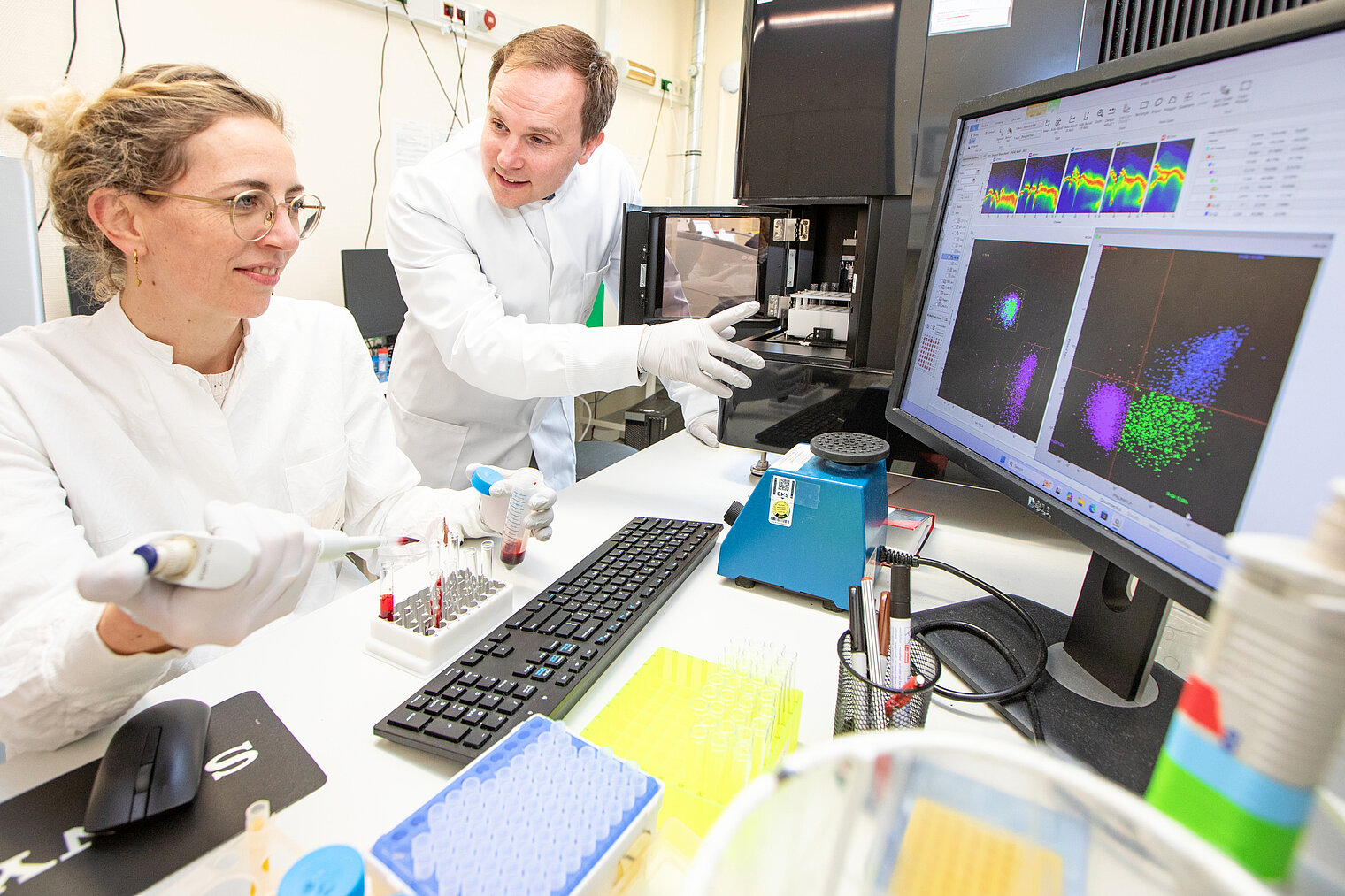
Graalmann Lab is aiming to solve clinical problems of immunocompromised patients suffering from frequent infectious diseases. In particular, patients with systemic autoimmune rheumatic diseases are immunosuppressed by the primary disease and additional immunomodulatory treatment.
In close collaboration with the Department for Rheumatology and Immunology of Hannover Medical School, we study pathophysiological mechanisms leading to chronic inflammatory diseases. Within such diseases, a specific focus lies on the origin of the connective tissue disease systemic sclerosis. Disease specific mechanisms are addressed using innovative methods to analyze immune cells derived directly from inflamed tissue of patients.
Chronic inflammatory diseases are treated using immunomodulatory drugs. Such drugs can influence immune responses upon infections and vaccinations. In order to develop better vaccination strategies for specific patient groups, we analyze the impact of immunomodulatory drugs on vaccination responses.
The treatment of chronic rheumatic diseases using immunomodulatory drugs has a systemic impact on immune responses. Using innovative nanocarriers, we aim to develop cell-selective targeting approaches to conduct active agents into affected immune cells. Such targeted therapy approaches might help to reduce infections caused by systemic immunomodulatory therapy.
Our Research
Graalmann Lab is aiming to solve clinical problems of immunocompromised patients suffering from frequent infectious diseases. In particular, patients with systemic autoimmune rheumatic diseases are immunosuppressed by the primary disease and additional immunomodulatory treatment.
In close collaboration with the Department for Rheumatology and Immunology of Hannover Medical School, we study pathophysiological mechanisms leading to chronic inflammatory diseases. Within such diseases, a specific focus lies on the origin of the connective tissue disease systemic sclerosis. Disease specific mechanisms are addressed using innovative methods to analyze immune cells derived directly from inflamed tissue of patients.
Chronic inflammatory diseases are treated using immunomodulatory drugs. Such drugs can influence immune responses upon infections and vaccinations. In order to develop better vaccination strategies for specific patient groups, we analyze the impact of immunomodulatory drugs on vaccination responses.
The treatment of chronic rheumatic diseases using immunomodulatory drugs has a systemic impact on immune responses. Using innovative nanocarriers, we aim to develop cell-selective targeting approaches to conduct active agents into affected immune cells. Such targeted therapy approaches might help to reduce infections caused by systemic immunomodulatory therapy.
Dr Dr Theresa Graalmann
Our research focuses on immune responses in tissue of patients with chronic rheumatic diseases, such as systemic sclerosis. Understanding of local inflammation can guide us to more precise therapy decisions and reduced infection complications in those vulnerable patients.

Theresa Graalmann is a clinician scientist in the Department of Rheumatology and Immunology at Hannover Medical School (MHH) and the principal investigator of the research group “Translational Immunology” at TWINCORE. Her research focuses on investigating inflammatory processes in the tissues of patients with rheumatic diseases and how these inflammatory processes influence the body’s defense against infection. Dr. Dr. Graalmann studied biology at Goethe University in Frankfurt and medicine at the MHH. During her doctoral studies, she investigated the influence of virus-induced type I interferon on murine T-cell responses at the Paul Ehrlich Institute in Langen and subsequently studied the direct and indirect effects of immunomodulatory drugs on human T-cell responses at TWINCORE. Throughout her medical studies, she worked part-time as a postdoctoral researcher at TWINCORE and, during this time, published numerous papers on cell-type- and tissue-specific immune responses to viral infections. Among other achievements, her junior research group has helped shed light on the role of TLR8 in the development of systemic sclerosis—a rare rheumatic disease—in the blood and skin. In addition, she has shed light on the role of T cells in the lungs of patients with systemic sclerosis. Overall, her work aims to refine our understanding of immune modulation in vulnerable patients in order to minimize the risk of infection.
Selected publications
- Ruwisch J, Cazes A, Leiber LM, Borie R, Neubert L, Christian L, Thomas de Montpréville V, Szmul A, Moussa F, Verleden SE, Gaedcke S, Hegermann J, Fuge J, Ballmaier M, Kamp JC, Greer M, Braubach P, Werlein C, Ius F, Graalmann T, Aburahma K, De Sadeleer LJ, Egashira R, Ackermann M, Yamada D, Hoeper MM, Falk C, Gottlieb J, Schiller HB, Vanaudenaerde B, Seeliger B, Debray MP, Bernaudin JF, Knudsen L, Bergot E, Jacob J, Mal H, Jonigk D, Dettmer S, Mordant P, Prasse A, Fadel E, Wuyts WA, Crestani B, Kaminski N, Justet A, Schupp JC. The pleuroparenchymal fibroelastosis atlas reveals aberrant cell states and their zonation as an alternate roadmap to lung fibrosis. Sci Adv. 2026 May 8;12(19):eaeb5967. DOI: 10.1126/sciadv.aeb5967
- Christian L, Yilmaz H, Ruwisch J, Giercke L, Seeliger B, Kamp JC, Bayraktar S, Ewen R, Graalmann T, Fuge J, Greer M, Ius F, Welte T, Liao SY, Yang IV, Hohlfeld JM, Hoeper MM, Gottlieb J, Kaminski N, Prasse A, Jonigk D, Li Y, Falk C, Neubert L, Schupp JC. Spatial transcriptomics uncovers hybrid, proinflammatory, and profibrotic cellular niches in pulmonary granuloma of patients with chronic sarcoidosis. Am J Respir Crit Care Med. 2026 Feb 1;212(2):338-350. DOI: 10.1093/ajrccm/aamaf089
- Ehlers C, Biermann H, Thiele T, Schupp JC, Villa M, Jänke C, Risser LM, Witte T, Kalinke U, Seeliger B*, Graalmann T*. T cells of patients with systemic sclerosis or Sjögren’s disease display an aberrant metabolic state and memory phenotype in blood and lungs. Rheumatology (Oxford). 2025 Aug 1;64(8):4806-4815. DOI: 10.1093/rheumatology/keaf198
- Ehlers C, Thiele T, Biermann H, Traidl S, Bruns L, Ziegler A, Schefzyk M, Bartsch LM, Kalinke U, Witte T, Graalmann T. Toll-Like Receptor 8 is Expressed in Monocytes in Contrast to Plasmacytoid Dendritic Cells and Mediates Aberrant Interleukin-10 Responses in Patients With Systemic Sclerosis. Arthritis Rheumatol. 2025 Jan;77(1):59-66. DOI: 10.1002/art.42964
- Graalmann T, Borst K, Manchanda H, Vaas L, Bruhn M, Graalmann L, Koster M, Verboom M, Hallensleben M, Guzmán CA, Sutter G, Schmidt RE, Witte T, Kalinke U.: B cell depletion impairs vaccination-induced CD8+ T cell responses in a type I interferon-dependent manner. Ann Rheum Dis. 2021 Dec;80(12):1537-1544. DOI: 10.1155/bmri/9979105
Publications
A complete list of publications can be found here.