Our Research
Infectious diseases caused by bacteria, viruses, parasites and fungi are responsible for more than a fifth of all human deaths annually. Despite improved hygiene and vaccinations, they still pose a global threat to human health. Even in industrialized countries, infections cause enormous social and economic damage through prolonged hospital stays and premature death. Unsurprisingly, infectious diseases make up the majority of the ten largest global health threats listed by the World Health Organization (WHO) in 2019.
HZI's Mission
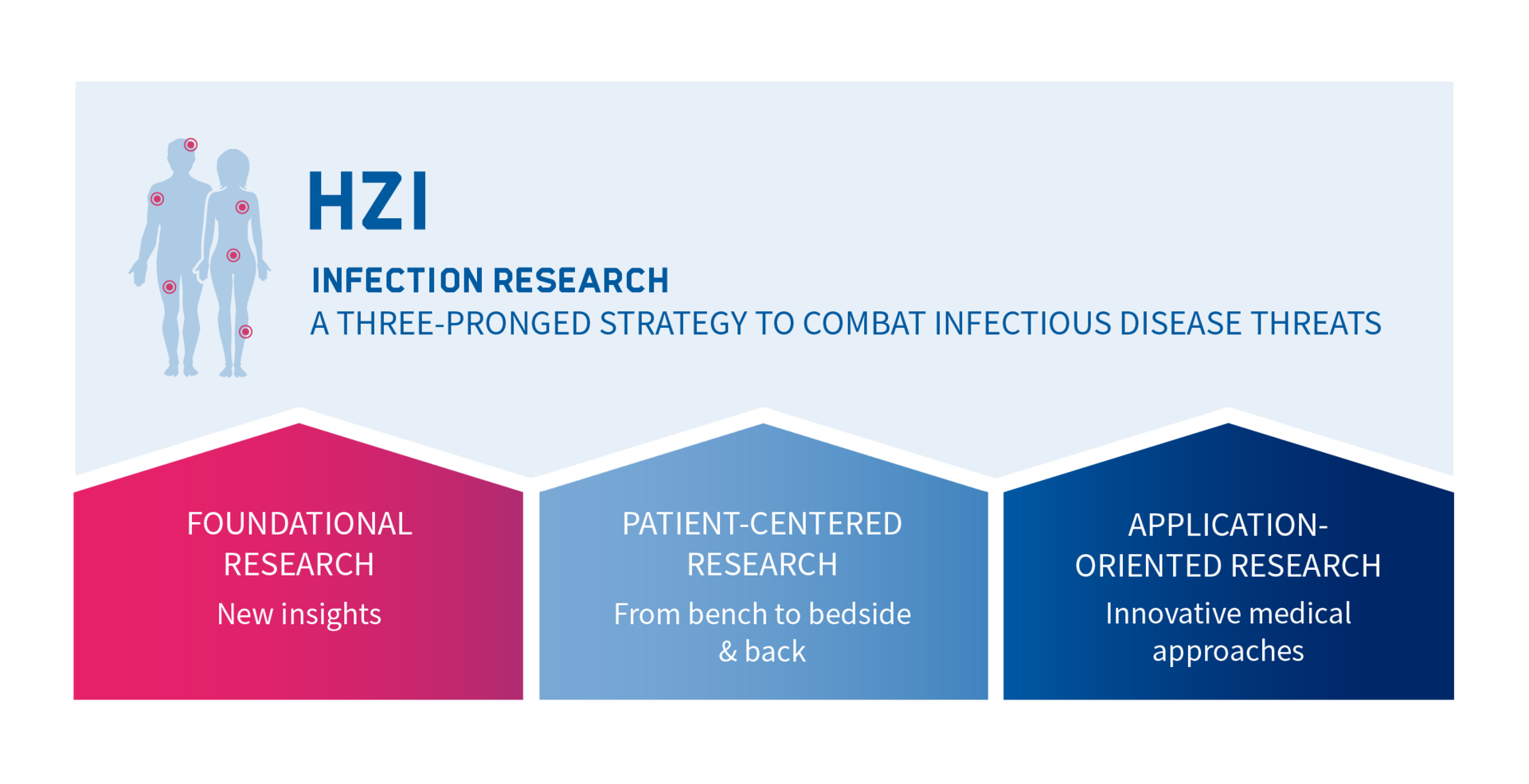
The central mission of the Helmholtz Centre for Infection Research (HZI) is to address the infectious disease challenges of the 21st century. To make this possible, HZI has implemented its interdisciplinary program “Infection Research”. The program puts particular emphasis on the transfer of research results to application. In line with the mission of the Helmholtz Association, HZI pursues long-term and strategic infection research addressing one of the greatest health threats facing society.
HZI scientists promote clinical and pharmaceutical innovation by combining groundbreaking fundamental research with patient-centered research and application-oriented research. To address the growing threats posed by bacterial and viral pathogens, this approach enables development of novel, patient-tailored solutions for diagnosis, prevention, treatment as well as surveillance and control of infectious diseases.
Translational Research - Achieving goals more efficiently through collaboration
Translation in infection research takes many forms, but it always serves a single purpose: closing the gap between basic research and clinical application.
Too often, findings from basic research fail to make their way into clinical practice or reach patients only after significant delays. Many innovations remain at a stage within academia that the pharmaceutical industry still considers too risky to pursue. At the HZI, however, translating research outcomes into medical and pharmaceutical applications is a central priority.
To support this process, the staff unit "Innovation Management and Technology Transfer" assists scientists in sustainably transferring technologies to external partners, including small and medium-sized enterprises as well as industry.
In order to form a continuous chain from basic research findings to therapies and preventive measures, the HZI is involved in several translational networks:
- German Center for Infection Research (DZIF)
- Translational Alliance of Lower Saxony (TRAIN)
- RESIST Cluster of Excellence
- NUCLEATE Cluster of Excellence
- Institute for Biomedical Translation (IBT) Lower Saxony
- PharmaScienceHub
The HZI does not provide care for patients itself, but works closely with clinical partner institutions. For example, the TWINCORE - Centre for Experimental and Clinical Infection Research and the Centre for Individualised Infection Medicine (CiiM) have been established in cooperation with the Hannover Medical School (MHH). Clinician scientists also have the opportunity to lead a research group at the HZI in parallel to their clinical work.


Good Scientific Practice
Manipulated data, theft of ideas, questionable authorship: Even in scientific research, there are sensitive, almost taboo topics that nobody likes to talk about. The mission of the ombudsman group at the HZI is to ensure that they are not swept under the carpet, but thoroughly clarified.
This independent committee, which has been installed according to the regulations and guidelines of the German Research Foundation (DFG), investigates all cases involving reasonable suspicion of scientific misconduct. It functions as a drop-in facility that can be approached, with confidentiality, by all members of staff at the centre.
The ombudsman group works independently and is not bound to directives from Management. In suspicious cases, they investigate comprehensively and have the right to confiscate and examine laboratory books, computers, data and records of every description.
Their investigative activities are concluded in the form of an extensive statement, in which the ombudsman group delivers an opinion and, if necessary, recommends appropriate measures.
Election of the Ombudsman Group
Members of the ombudsman group are elected for five years by the scientific employees of the HZI. All employees are eligible who 1) are involved in research and development tasks and 2) possess either a university or polytechnic degree.
The ombudsman committee of the HZI consists of the following scientists:
- Dr Katharina Rox (Speaker)
- Prof Dr Theresia Stradal (Deputy Speaker)
- Dr Jan Frederik Gogarten
- Dr Miriam Große
- Dr rer nat Tilman Klassert
Principles of good scientific practice and regulations of the HZI
Several important principles for securing good scientific practice were formulated in 1998 by a commission of the German Research Foundation (DFG). This includes, for example, the commitment to retain primary data from research for ten years, in order to be able to execute retroactive and complete examinations.
As regards scientific specialist publications, all authors, in compliance with DFG recommendations, should jointly assume responsibility for correctness of the content. Inclusion of a neutral and independent contact facility, e.g. in the form of an ombudsman committee, is required in the DFG guidelines.
Based on the recommendations from the German Research Foundation (DFG), the HZI has provided binding regulations to make sure that legitimate scientific work is carried out.