Antiviral Immunity of Bacteria

Our Research
Antiviral Bacterial Immunity
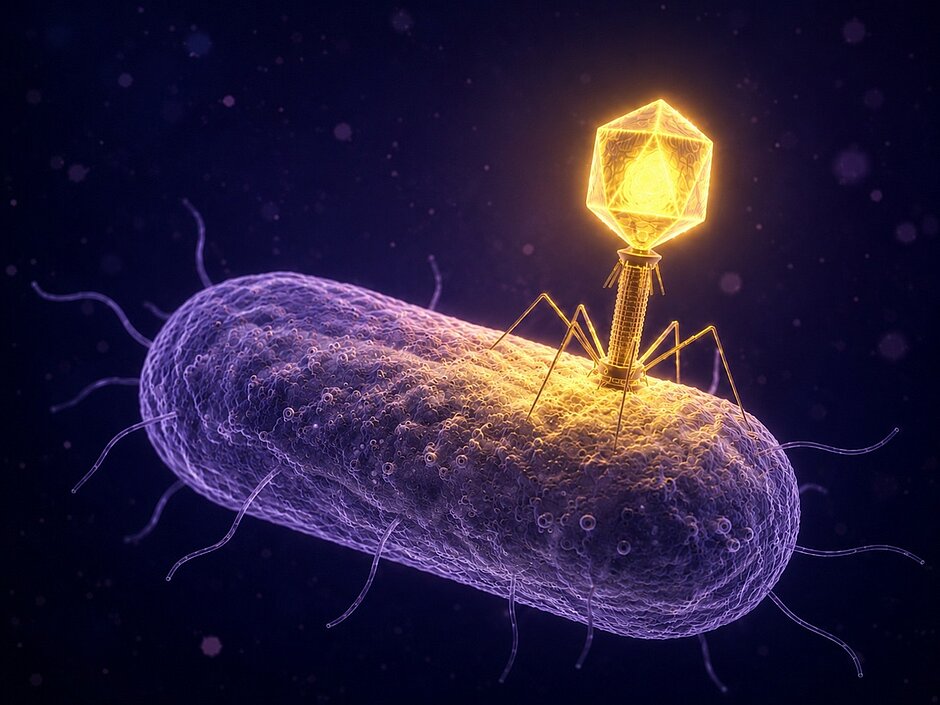
Bacteriophages show strong potential as treatments for bacterial infections, but their clinical use is limited by specificity: they often infect only certain bacterial strains and are unable to kill other clinical isolates. One of the main reasons for this phage specificity is the emergence of unique antiviral protective barriers in different bacterial strains, which make them resistant to phages. Bacterial antiviral immune systems are highly diverse. To better withstand surrounding viral threats, bacterial strains constantly acquire immune genes by inserting mobile genetic elements, such as transposons, into their genomes. This leads to the emergence of immune gene clusters, “defense islands”, which could include dozens of different antiviral genes. We study how “defense islands” form, how they are regulated, and how they provide antiviral protection, using clinical strains of Pseudomonas aeruginosa and Burkholderia cenocepacia. Our goal is to identify the barriers phages face and enhance bacteriophages to overcome them, enabling more efficient phage therapy.
Anti-immune phage genes

Similar to bacteria, phages use horizontal gene transfer to acquire genes that allow them to counter bacterial defenses and overcome bacterial immunity. These genes are often encoded in phage genomes as anti-defense hotspots. Using genetic and biochemical approaches, we aim to understand the role of these anti-defense genes in phage infectivity.
Phage engineering
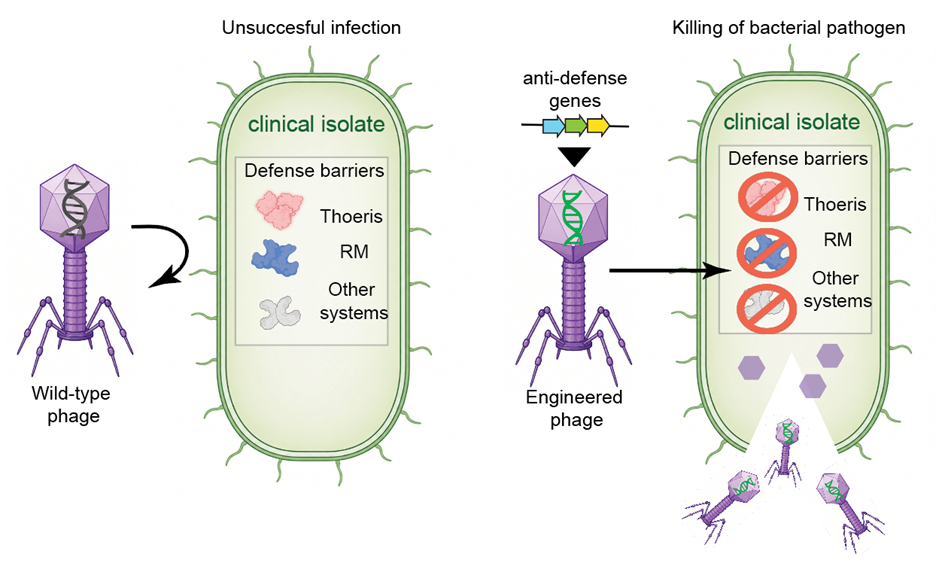
Phages constantly acquire new genes and modify their genome to overcome bacteria in their battle. We aim to do this in the laboratory and believe that rational phage engineering will help create more effective phage therapy approaches.
Our Research
Antiviral Bacterial Immunity
Bacteriophages show strong potential as treatments for bacterial infections, but their clinical use is limited by specificity: they often infect only certain bacterial strains and are unable to kill other clinical isolates. One of the main reasons for this phage specificity is the emergence of unique antiviral protective barriers in different bacterial strains, which make them resistant to phages. Bacterial antiviral immune systems are highly diverse. To better withstand surrounding viral threats, bacterial strains constantly acquire immune genes by inserting mobile genetic elements, such as transposons, into their genomes. This leads to the emergence of immune gene clusters, “defense islands”, which could include dozens of different antiviral genes. We study how “defense islands” form, how they are regulated, and how they provide antiviral protection, using clinical strains of Pseudomonas aeruginosa and Burkholderia cenocepacia. Our goal is to identify the barriers phages face and enhance bacteriophages to overcome them, enabling more efficient phage therapy.
Anti-immune phage genes
Similar to bacteria, phages use horizontal gene transfer to acquire genes that allow them to counter bacterial defenses and overcome bacterial immunity. These genes are often encoded in phage genomes as anti-defense hotspots. Using genetic and biochemical approaches, we aim to understand the role of these anti-defense genes in phage infectivity.
Phage engineering
Phages constantly acquire new genes and modify their genome to overcome bacteria in their battle. We aim to do this in the laboratory and believe that rational phage engineering will help create more effective phage therapy approaches.
Dr. Iana Fedorova
Phages are naturally evolving antimicrobial agents that I believe will help us treat multidrug-resistant infections.

Iana Fedorova studied biophysics at Peter the Great St. Petersburg Polytechnic University in Russia. During her PhD, she worked in Professor Konstantin Severinov's Laboratory at Skolkovo Institute of Science and Technology (Russia) and Professor Feng Zhang's Laboratory at the Broad Institute (USA), where she studied CRISPR-Cas systems and developed genome-editing tools based on Cas nucleases. After receiving her PhD from Skolkovo Institute of Science and Technology in 2020, Dr. Fedorova became interested in the biology of antiviral prokaryotic immune systems. In 2021, she established a research group at Peter the Great Saint Petersburg Polytechnic University to study antiviral immunity in archaea and bacteria. In 2022, she moved to the USA to learn genetic approaches and study bacteriophages as a postdoctoral scientist in the Laboratory of Joseph Bondy-Denomy at UCSF. During her work at UCSF, Dr. Fedorova unveiled various strategies that phages use to overcome antiviral bacterial signaling-based defenses (TIR- and cGAS-like systems). In 2026, Iana Fedorova established the junior research group Antiviral Immunity of Bacteria (AIBA) at HZI to understand which antiviral barriers clinical bacterial strains use to resist phages, with the aim of improving phage therapy.
Selected Publications
- Fedorova I.*; Yue Y.*, et al., Balancing of immune activation and suppression during phage infection, BioRxiv, 2025 DOI: 10.64898/2026.06.04.730250
- Li D.*; Xiao Y.*; Fedorova I.*, Xiong W.*; Wang Y.*; Liu X.* et al., Single phage proteins sequester TIR- and cGAS-generated signaling molecules. Nature. 2024 DOI: 10.1101/2023.11.15.567273
- Fedorova, I.*; Arseniev, A.* et al., DNA Targeting by Clostridium Cellulolyticum CRISPR-Cas9 Type II-C System. Nucleic Acids Res. 2020 DOI: 10.1093/nar/gkz1225
- Fedorova, I*.; Vasileva, A*. et al., PpCas9 from Pasteurella pneumotropica - a compact Type II-C Cas9 ortholog active in human cells. Nucleic Acids Res. 2020 DOI: 10.1093/nar/gkaa998
- Selkova, P. et al., Position of Deltaproteobacteria Cas12e nuclease cleavage sites depends on spacer length of guide RNA. RNA biology. 2020 DOI: 10.1080/15476286.2020.1777378
*contributed equally
A complete list of publications can be found here.
Newsroom