



Newsroom

[Translate to English:]
News
The Alliance of Science Organisations in Germany expresses its deepest condolences for the victims of the terrorist attacks on Israel. In particular, our sympathy is with our friends and colleagues in the Israeli scientific community. Israel has been and will always be a prime partner for the German research and innovation community.
12.10.2023
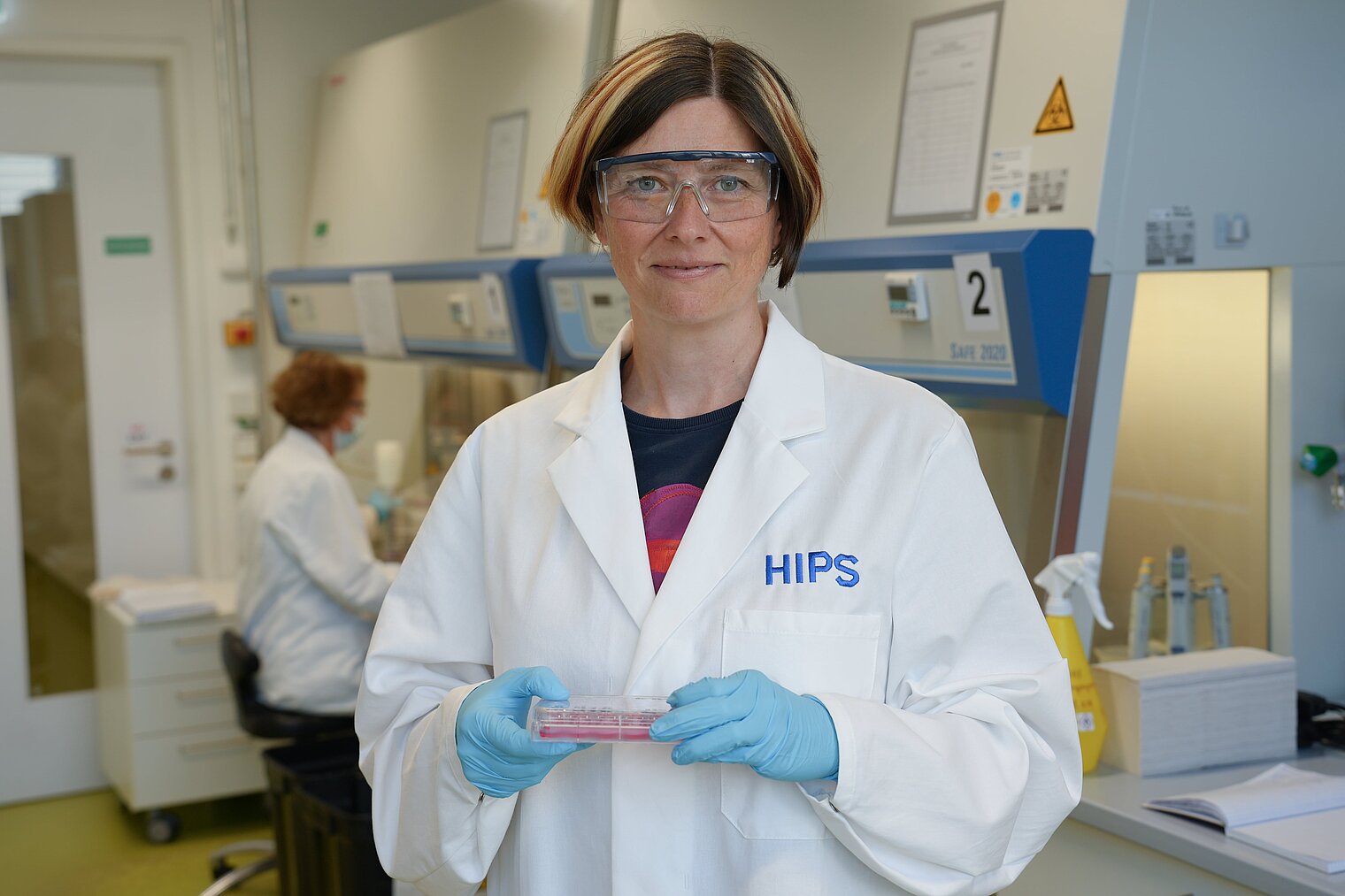
New findings on SARS-CoV-2: Jun Prof Mathias Munschauer with PhD student Sabina Ganskih in the lab.
News
How SARS-CoV-2 initiates its replication process during infection is not yet fully understood. Researchers from the Helmholtz Institute Würzburg have now shown for the first time in the journal Cell that it is the human protein SND1 which works together with the viral protein NSP9 to stimulate the virus’s genetic replication program in infected cells. The scientists were surprised to find that NSP9 acts as the first building block in the production of new viral genetic material. The findings are significant for further basic research, but they could also lead to new avenues for the treatment of COVID-19 and other infectious diseases caused by coronaviruses.
04.10.2023
The Microbelix team at the award ceremony at the Museum für Naturkunde in Berlin ©WID/Gesine Born
News
The cooperation project MICROBELIX was jointly launched in spring 2023 by researchers from the Helmholtz Institute for Pharmaceutical Research Saarland (HIPS) and the Naturlandstiftung Saar (NLS). Together, both institutions set out to compete in the citizen science contest Auf die Plätze! Citizen Science in deiner Stadt. After a public voting phase and the evaluation by a jury of experts, the MICROBELIX team could claim one of the three winning places and a 50,000 € prize. The award ceremony took place on September 28, 2023 at the Museum für Naturkunde in Berlin.
28.09.2023
Mosquito bites into human skin
News
Saarbrücken, 21. September, 2023 - Researchers at the Helmholtz Institute for Pharmaceutical Research Saarland (HIPS) have again succeeded in acquiring funding under the BMBF-funded "GO-Bio Iinitial" program. The funding measure aims to identify promising research approaches in the life sciences, to exploit their innovation potential and to enable a seamless transfer into application. In the now funded project "ChloroMalaria-2", a novel class of natural products for the treatment and control of malaria will be further optimized.
21.09.2023
Stephanie Pfänder, winner of this year's Jürgen Wehland Award.
News
Virologist and Jun Prof Stephanie Pfänder has been awarded the Jürgen Wehland Award 2023. A scientist in the Department of Molecular and Medical Virology at the Ruhr-Universität Bochum, her research focuses on so-called emerging viruses, in particular coronaviruses. She received the award during a ceremony attended by the Mayor of Braunschweig, Anke Kaphammel, and guests from science and the alumni network of the Helmholtz Centre for Infection Research (HZI). This is already the ninth time that the HZI has awarded the Jürgen Wehland Award, which is endowed with 5,000 euros, to honour young scientists who have made outstanding contributions to the field of infection research. The award ceremony took place at the HZI Forum event centre in Braunschweig.
15.09.2023
Swabbing a leaf to collect vertebrate eDNA in the Greifswald Botanical Garden.
News
In a new study, an international research team shows that the very cotton buds, which we all got to know so intimately during the COVID-19 pandemic, are a valuable tool to map biodiversity. This was the result of an international research team led by scientists at the Helmholtz Institute for One Health (HIOH) in Greifswald, a site of the Helmholtz Centre for Infection Research (HZI) in Braunschweig, Germany. In essence, the researchers demonstrate that a vast multitude of birds and mammals can be detected by simply swabbing the DNA left behind by animals from leaves. They showcased the power of this approach in an ecosystem that hosts a ton of wildlife and where detecting animals has historically proven extremely challenging - the tropical rainforest. The study was published in Current Biology.
22.08.2023

HZI in the media

Eine Impfung bringt das Immunsystem in Stellung, bevor der echte Erreger kommt. Erfahren Sie, wie ...

26.02.2026
|
Apotheken Umschau

Handeln für mehr Klimaresilienz forderte Josef Penninger, wissenschaftlicher Geschäftsführer des Helmholtz Zentrums für Infektionsforschung ...

26.02.2026
|
Deutscher Bundestag

Livia V. Patrono, one of the senior authors at the Helmholtz Institute for One Health (HIOH) in Germany, said in a statement .


The research

25.02.2026
|
IFL Science

says Livia Patrono, a veterinarian and disease ecologist at Helmholtz Institute for One Health in Greifswald, Germany. In 2012, an infected

24.02.2026
|
Science News

... Dr. rer. nat. Jakob Wirbel vom Helmholtz-Zentrum für Infektionsforschung (Braunschweig). Das Experiment aus Stanford sei ...

20.02.2026
|
Deutsches Ärzteblatt

... unseres Immunsystems zu entziehen. Strukturbiologen des Helmholtz-Zentrums für Infektionsforschung (HZI) konnten nun mittels ...

18.02.2026
|
Bionity.COM

of our immune system. Structural biologists at the Helmholtz Center for Infection Research (HZI) have now used cryo-electron microscopy to

16.02.2026
|
Phys.org

Was es mit Mpox – früher Affenpocken genannt – auf sich hat, welche Symptome erkrankte Personen haben und wie man sich anstecken kann.

13.02.2026
|
Apotheken Umschau

Julia Port, research group leader at Germany's Helmholtz Center for Infection Research.


"Ongoing outbreaks—particularly those driven by

12.02.2026
|
Medical Xpress

... Livia Patrono, laut einer Mitteilung des beteiligten Helmholtz-Instituts für One Health (HIOH): Denn dadurch ...

12.02.2026
|
n-tv

... für den Neubau der Klinik für Strahlentherapie Würzburg sowie für das Helmholtz-Institut für RNA-basierte ...

12.02.2026
|
Main-Post - Karlstadt

Project


Researchers at the Helmholtz Institute for One Health (HIOH), a site of the Helmholtz Centre for Infection Research (HZI), together

11.02.2026
|
NewsBreak

Register now for the HZI-Newsletter