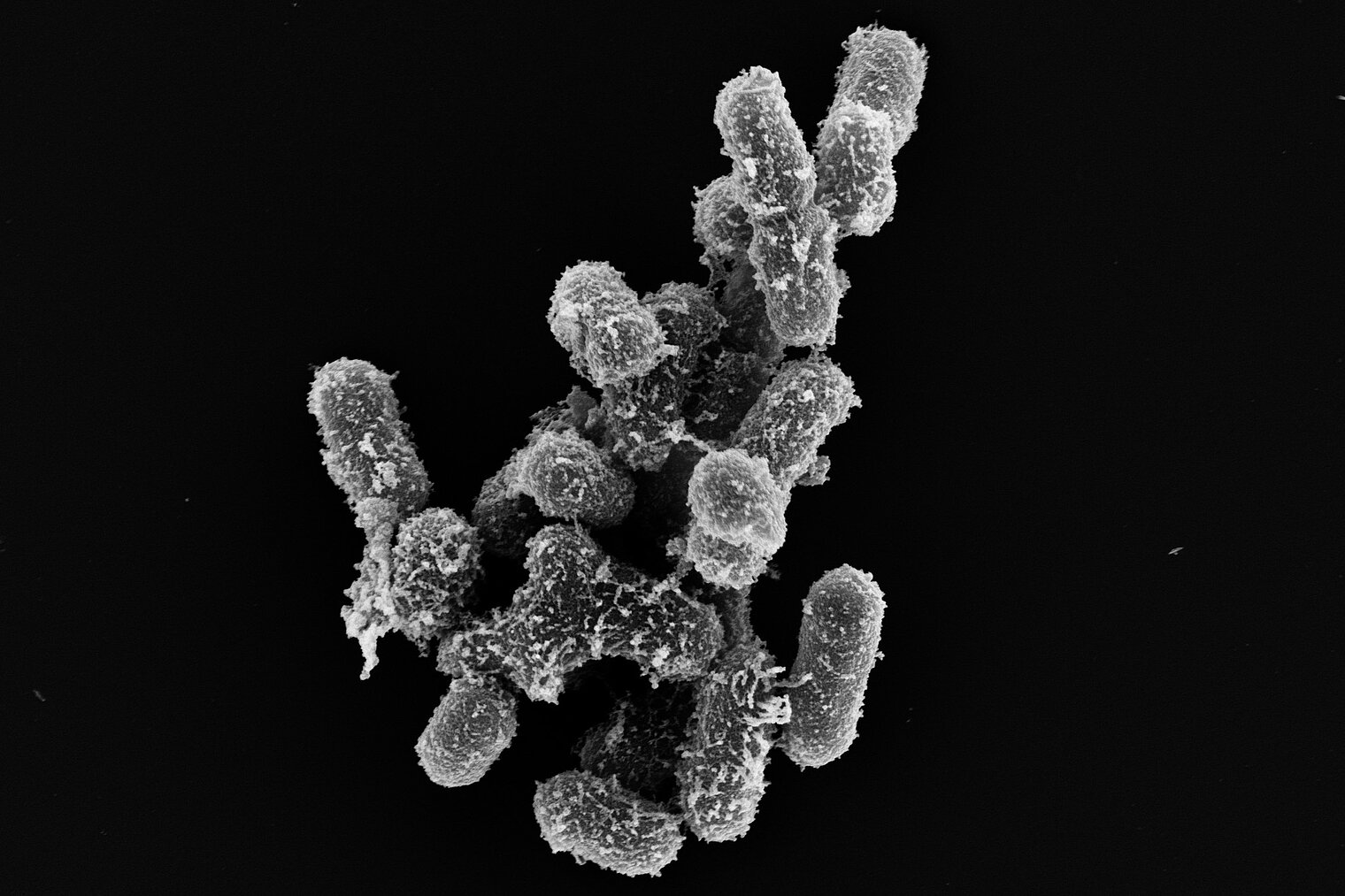
Billions of microorganisms—primarily bacteria, viruses, and fungi—colonize our gut. This complex community is known as the microbiome. When the microbiome is diverse and in balance, it has a positive effect on our health: digestion runs smoothly, and pathogens cannot harm us as easily. However, not all microbiomes are the same; they differ from person to person. Yet there are patterns. Studies have shown that in regions of the world such as Africa or Asia, where a more traditional lifestyle still prevails, bacteria of the genus Segatella dominate the human gut microbiome. “In industrialized countries, representatives of the genus Segatella are also present in the gut, but the microbiome is dominated by bacteria of the genus Bacteroides,” says Prof. Till Strowig, head of the department “Microbial Immune Regulation” at the HZI and last author of the study. “With this study, we wanted to get a little closer to answering the question of why.”
In their first experiment, the researchers investigated the oxygen tolerance of Segatella copri, likely the most common gut bacterium worldwide. Whether oxygen is present in their habitat or not is crucial for bacteria. There are bacteria that—like us humans—require oxygen for their metabolism. Others, however, do not necessarily need oxygen or do not need it at all, but can tolerate it in small amounts. For some bacteria, oxygen can even be toxic. “In a healthy gut, there is usually very little oxygen present, and in most areas, none at all. For bacteria that cannot cope with oxygen, or cannot cope with it very well, this is therefore an optimal habitat,” says Dr. Youssef El Mouali, a scientist on Till Strowig’s team and one of the study’s first authors. For their investigations, the researchers used various bacterial strains of the species Segatella copri as well as the bacterial model organism Bacteroides thetaiotaomicron for comparison. “Over a period of 30 minutes, we exposed the bacteria to a defined oxygen concentration,” explains Dr. Caroline Tawk, a scientist in Strowig’s team and also a first author of the study. “It is well known that Bacteroides species can tolerate the presence of oxygen well. In comparison, the survival rate of Segatella copri was 100,000 times lower.”