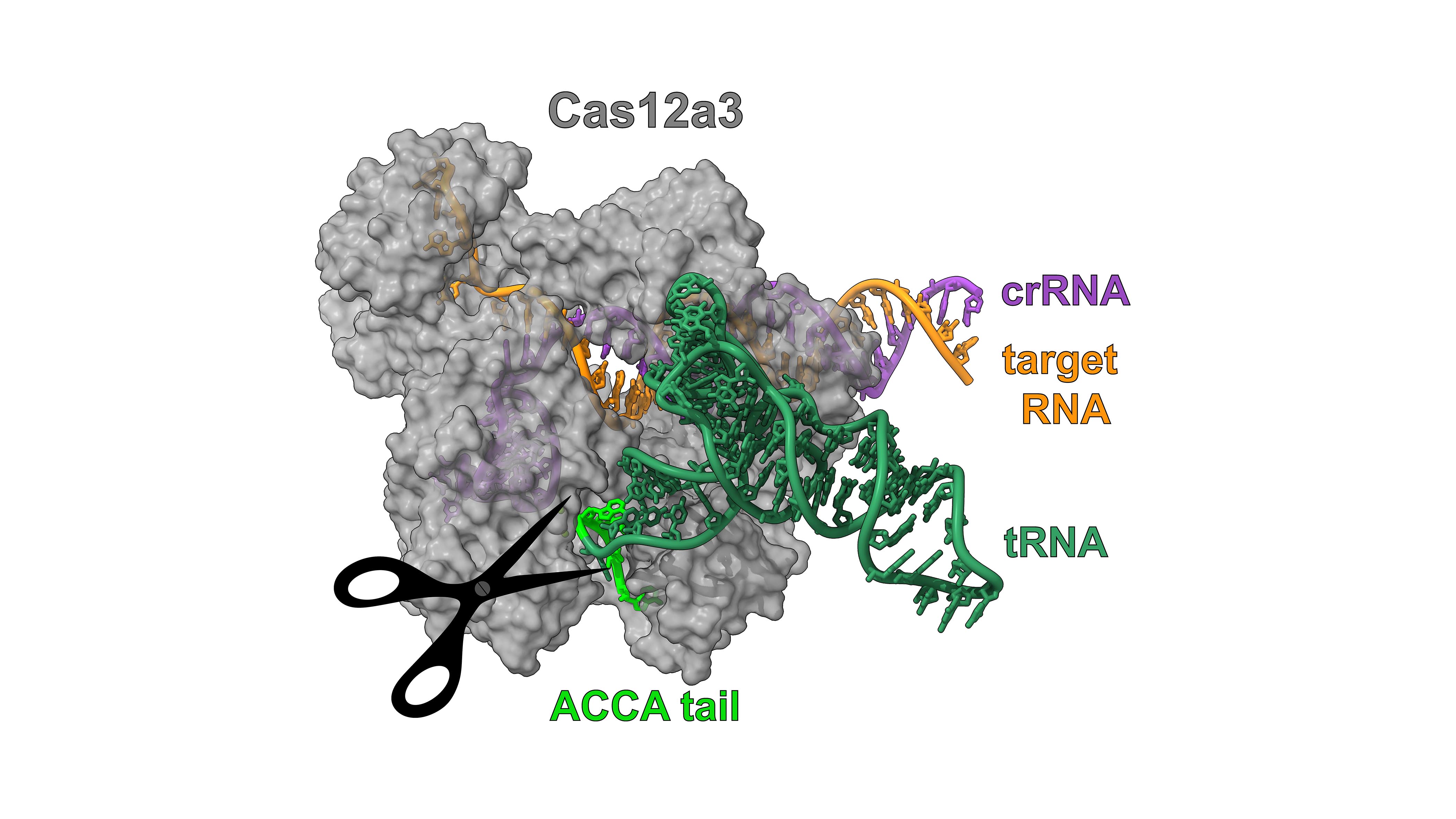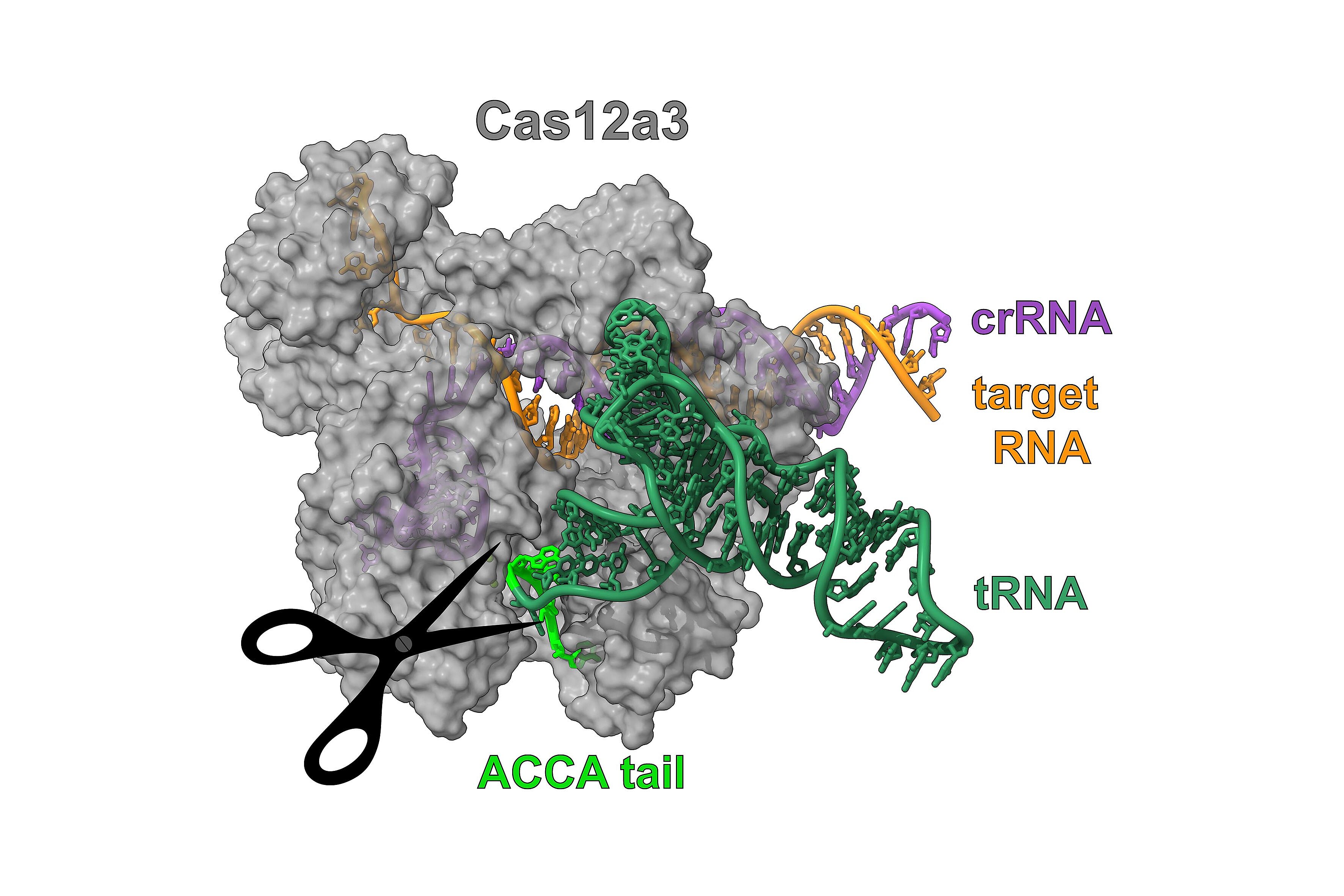
Cryo-electron microscope image of the nuclease Cas12a3 with illustrated scissors
Cryo-electron microscope structure of the nuclease Cas12a3 cleaving the tail of a transfer RNA (tRNA).
News

Beyond gene scissors: New CRISPR mechanism discovered

Team from Würzburg, Braunschweig, and the US identifies Cas12a3 nuclease showing precise activity | Study just published in Nature

The CRISPR “gene scissors” have become an important basis for genome-editing technologies in many fields, ranging from biology and medicine to agriculture and industry. A team from the Helmholtz Institute for RNA-based Infection Research (HIRI) in Würzburg has now demonstrated that these CRISPR-Cas systems are even more versatile than previously thought. In cooperation with the Helmholtz Centre for Infection Research (HZI) in Braunschweig and Utah State University (USU) in Logan (USA), the scientists have discovered a novel CRISPR defense mechanism: Unlike known nucleases, Cas12a3 specifically destroys transfer ribonucleic acids (tRNA) that are vital for protein production to shut down infected cells. The team published its findings today in the journal Nature.

Bacteria contain a wide variety of mechanisms to fend off invaders like viruses. One of these strategies involves cleaving transfer ribonucleic acids (tRNA), which are present in all cells and play a fundamental role in the translation of messenger RNA (mRNA) into essential proteins. Their inactivation limits protein production, causing the infected cell to go dormant. As a result, the attacker cannot continue to replicate and spread within the bacterial population.

One common bacterial defense that has so far not been associated with tRNA cleavage are CRISPR-Cas systems. CRISPR uses RNA-guided proteins, known as Cas nucleases (from CRISPR-associated), to recognize invaders based on their genetic material and deactivate them. Once they identify a pathogen, the nucleases trigger an immune response unique to each system. This includes, for example, cleaving foreign DNA or halting growth through widespread RNA and DNA degradation. These mechanisms have already been employed by mankind in many ways, and CRISPR has been recognized as an important foundation for genome-editing technologies. However, it was not known until now that CRISPR-Cas also preferentially targets tRNAs as part of an immune response.

An unexpected discovery

Researchers at the Helmholtz Institute for RNA-based Infection Research (HIRI), a site of the Braunschweig Helmholtz Centre for Infection Research (HZI) in cooperation with the Julius-Maximilians-Universität Würzburg (JMU), have collaborated with scientists from the HZI and Utah State University (USU) to discover a novel CRISPR mechanism that targets tRNAs. “These findings were completely unexpected,” says Chase Beisel, affiliated department head at the HIRI and corresponding author of the study, which was published today in the journal Nature. “Our team was actually working on proteins associated with a unique nuclease called Cas12a2”, adds Beisel. 

In two studies published in the journal Nature in January 2023, teams that included Chase Beisel described how they had found Cas12a2 in a family of nucleases that exclusively cleave DNA. In contrast, Cas12a2 was able to broadly cleave both RNA and DNA. “We hypothesized that this protein family might contain other special functions. And we were right: we found Cas12a3 with its unique properties,” adds Oleg Dmytrenko, former postdoc in the Beisel lab and first author of the study recently published in Nature.

The polar opposite

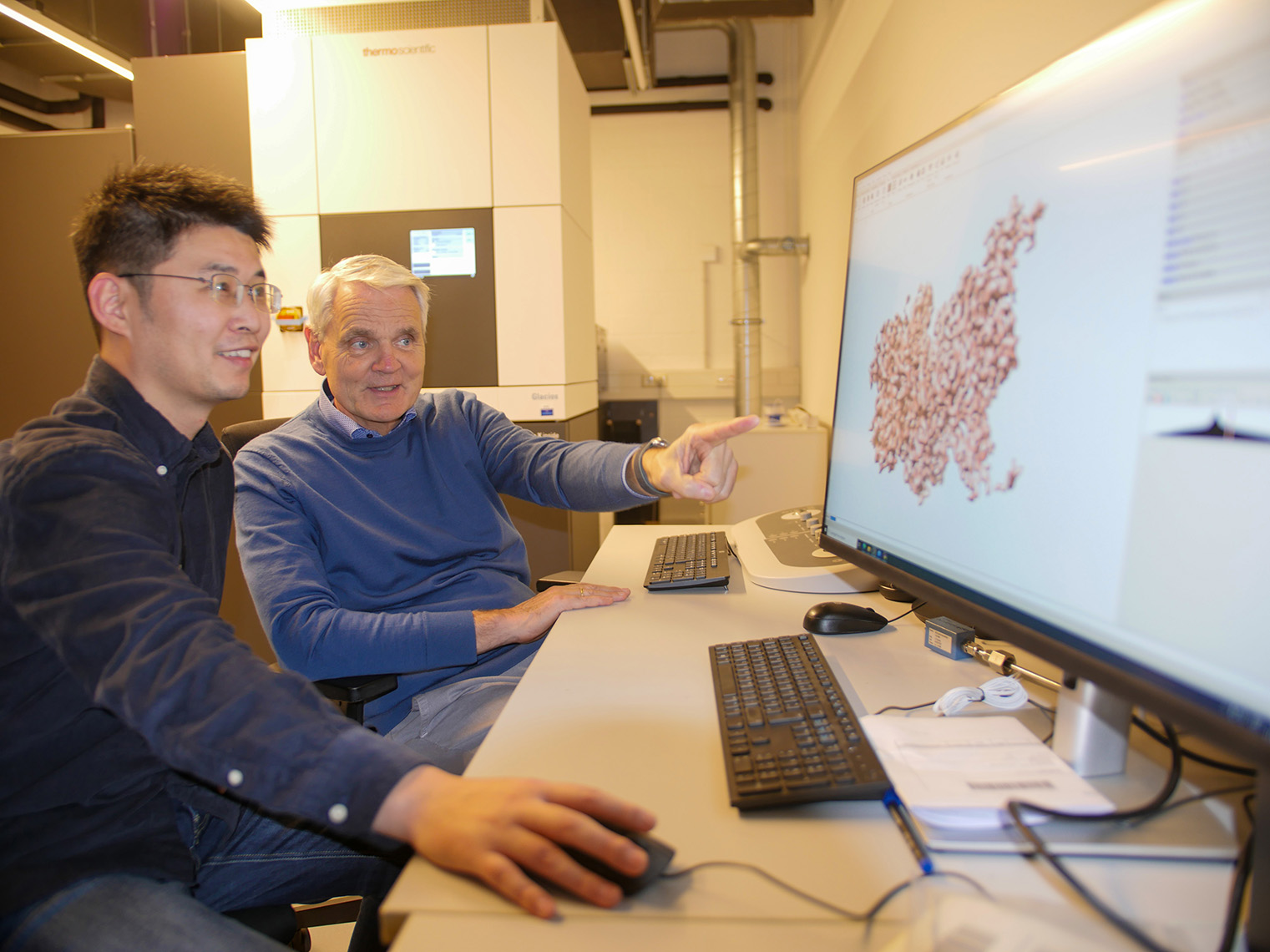
Biao Yuan and Dirk Heinz in front of a PC
Biao Yuan and Dirk Heinz discuss a protein structure that they recorded using cryo-electron microscopy.

Like Cas12a2, Cas12a3 also uses an RNA guide to recognize foreign RNA sequences. However, a match causes Cas12a3 to change its shape, then bind and cleave a specific region of the tRNA, namely its tail. “This precision makes Cas12a3 the polar opposite of its closest relative, Cas12a2, which cuts non-specifically but comprehensively,” says Ryan Jackson, professor at USU and also a corresponding author of the study.

The so-called 3' tail is the most conserved part of all tRNAs. This means that it has remained the same across many organisms. This region is crucial for the function and stability of tRNA and has therefore hardly changed evolutionarily. An activated amino acid, the principal building block of proteins, is attached to it. During protein translation, amino acids are transferred from the tRNA to the growing polypeptide chain. Therefore, removing the tRNA tail is an effective way to block protein production, a process that is vital for the cell.

The structure of Cas12a3, which the team was able to uncover using cryo-electron microscopy at the HZI, reveals how the nuclease recognizes tRNAs: “We were able to identify a unique part that we have named the ‘tRNA loading domain’,” explains Dirk Heinz, department head at the HZI and co-corresponding author. “Its task is to precisely position the tRNA-3’-tail in the right spot for cleavage,” adds Biao Yuan, postdoc in the Heinz lab and also first author of the article.

The researchers were able to directly exploit this high precision: they combined Cas12a3 with two other nucleases that also cleave precisely but focus on other distinct RNAs. By doing so, the team was able to simultaneously detect RNAs from three different viruses – the influenza virus, the respiratory syncytial virus (RSV), and SARS-CoV-2. “This not only enabled us to push the boundaries of CRISPR-based diagnostics. Our research findings could also pave the way for cost-effective and easy-to-perform point-of-care tests for a wide range of diseases,” says Beisel.

A hidden diversity

The cleavage of tRNA tails represents a new CRISPR immune response and demonstrates the diverse ways in which bacteria can fight off infections. The work thus sheds light on the huge functional diversity that is hidden in already known bacterial defense mechanisms and needs to be investigated.

The research team has already planned its next steps: “In the hope of discovering further variations, we want to explore this tiny section of the CRISPR defense mechanisms in even greater depth,” Heinz says, looking ahead. “In addition, we plan to make Cas12a3 usable as a technology for molecular diagnostics and other applications”, concludes Jackson.

Collaborations

This study is the result of a collaboration between the laboratories of Chase Beisel and Redmond Smyth at the Helmholtz Institute for RNA-based Infection Research in Würzburg, the Helmholtz Centre for Infection Research in Braunschweig, Utah State University in the USA, Jagiellonian University in Poland, and the Institute of Science and Technology Austria (ISTA) in Austria.

Funding

This work was supported by grants from the European Research Council (grant to Chase Beisel), the R. Gaurth Hansen family (funding for Ryan Jackson), the National Institutes of Health (funding for Ryan Jackson), the “PostDoc Plus” program of the Graduate School of Life Sciences at Julius-Maximilians-Universität Würzburg (funding for Oleg Dmytrenko), the German Research Foundation (DFG) as part of Germany's Excellence Strategy – the Berlin Mathematics Research Center MATH+ (funding for Max von Kleist), and the Helmholtz Association.

(Kopie 2)

Original publication

Dmytrenko O, Yuan B, Crosby KT, Krebel M, Chen X, Nowak JS, Chramiec-Głąbik A, Filani B, Gribling-Burrer AS, van der Toorn W, von Kleist M, Achmedov T, Smyth RP, Glatt S, Bravo JPK, Heinz DW, Jackson RN, Beisel CL, (2026), RNA-triggered Cas12a3 cleaves tRNA tails to execute bacterial immunity. Nature. DOI: 10.1038/s41586-025-09852-9

Portrait Luisa Macharowsky

Press contact

Luisa Härtig
Manager Communications