


Newsroom

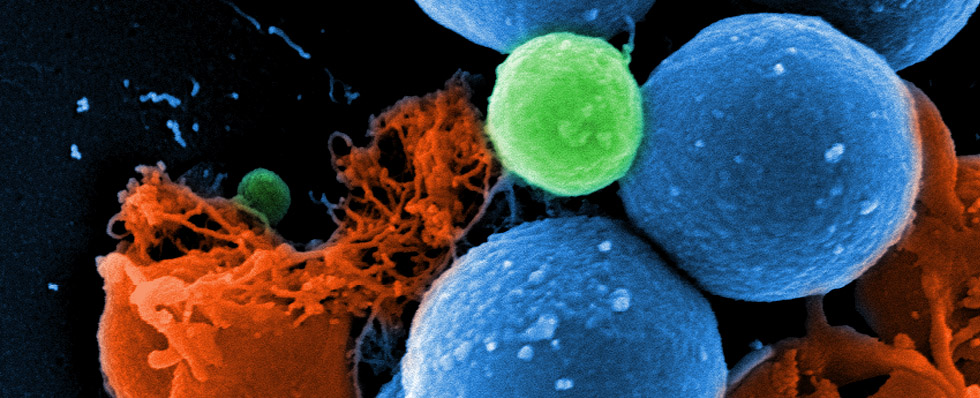
Elektronenmikroskopische Aufnahme von Staphylococcus aureus
News
According to the World Health Organization (WHO), infections with antibiotic-resistant bacteria are one of the greatest threats to global health. In order to alleviate this problem, researchers explore new applications for already existing antibiotics in addition to the search for new active substances. Until now, the antibiotic mupirocin could only be applied locally to treat skin infections. Encapsulating the drug into nanoparticles would enable to broaden its range of applications. Researchers at the Helmholtz Centre for Infection Research (HZI) in Braunschweig, together with colleagues at The Hebrew University of Jerusalem, Israel, have shown that nanotechnology enables a systemic application of mupirocin. The study was published in the Journal of Controlled Release.
03.01.2020
Rasterelektronenmikroskopische Aufnahme von intakten MRSA
News
The bacterium Staphylococcus aureus can be part of the normal bacterial population inhabiting our body, but can also cause serious infections. This bacterium has often developed resistance to standard antibiotics or even multi-resistance to several antibiotics such as methicillin-resistant Staphylococcus aureus (MRSA). Particularly in hospitals, MRSA is often the cause of severe and difficult-to-treat infections. Therefore, there is an urgent need for new drugs that can effectively treat MRSA infections. In order to shorten the lengthy and expensive development process, scientists at the Helmholtz Centre for Infection Research (HZI) in Braunschweig and the Technical University of Munich (TUM) have used an innovative approach to antibiotic development. The researchers used chemical synthesis to significantly improve the antimicrobial properties of an approved cancer medicament that also has a moderate killing activity on MRSA. The resulting molecule, named PK150, is highly effective against MRSA infections without the development of resistance. The results are published in the journal Nature Chemistry.
16.12.2019
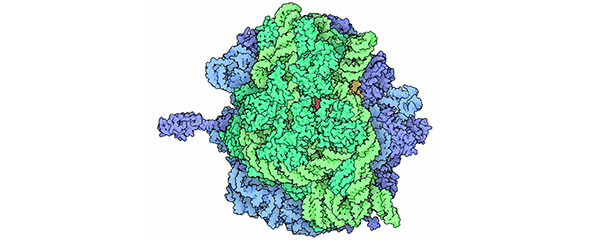
Schematische Darstellung eines Ribosoms
News
In the genetic blueprint for proteins, the information for each amino acid is encoded by codons. A codon consists of three consecutive building blocks of messenger RNA (mRNA), a base triplet that encodes exactly one amino acid. During protein synthesis, adaptor molecules - called tRNAs - specifically base-pair with the codon and bring the correct amino acid into the catalytic center of the ribosome, where it is attached to the growing peptide chain. Although this process has been thought to be highly accurate, on specific mRNAs ribosomes can be programmed to move by one base and thus change the meaning of all following codons. This phenomenon is called programmed ribosomal frameshifting (PRF) and is used in all domains of life, especially by pathogens such as viruses. As all downstream codons are affected, PRF can strongly alter the structure and function of the resulting protein. Junior Professor Neva Caliskan from the Helmholtz Institute for RNA-based Infection Research (HIRI) in Würzburg, a joint institution of the Helmholtz Centre for Infection Research in Braunschweig and the Julius Maximilian University Würzburg, collaborated with researchers from the Max Planck Institute for Biophysical Chemistry (MPI-BPC) to develop a model to calculate the frameshift efficiency from the free energy of base pairing. Using this approach, the researchers can now predict sites in the genome where PRF is likely to occur, giving rise to altered proteomes. The study was recently published in the journal Nature Communications.
12.12.2019
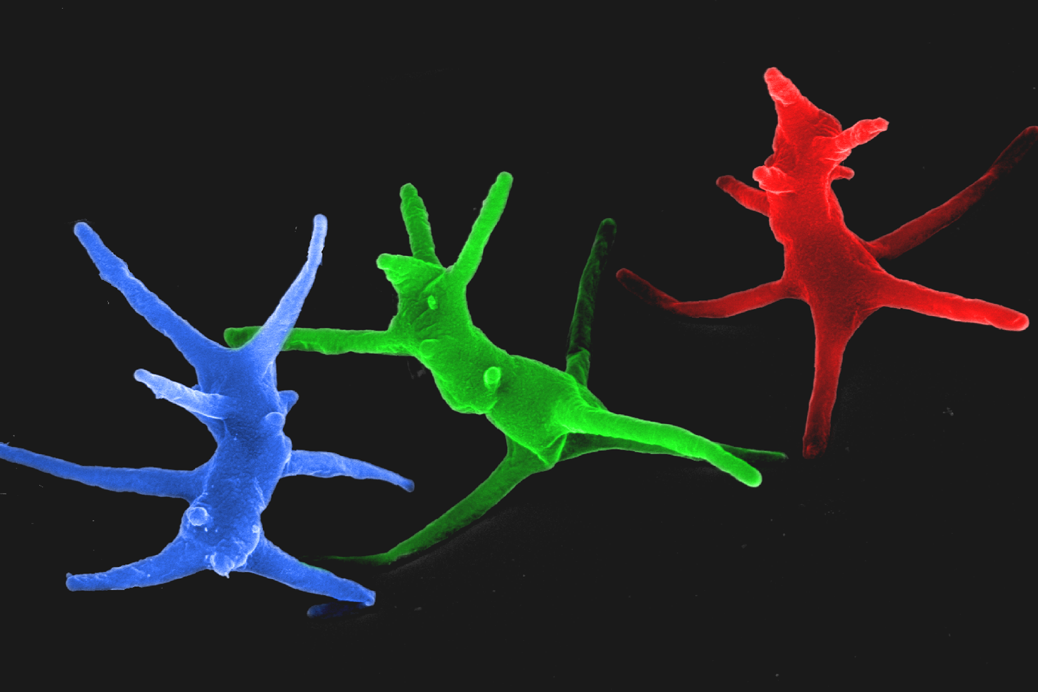
Electron microscopic image of the bacterium Prosthecomicrobium hirschii in blue, green and red
Story
Electron microscopy (EM) is not some monotonous assembly-line job, because each assignment poses new challenges. A diverse range of things is magnified and examined, such as immune cells, algae or phages – the work is always different and always interesting. However, biological EM is only practiced by four specialists in Germany. One of these highly qualified experts is Manfred Rohde at the Helmholtz Centre for Infection Research (HZI).
09.12.2019
Rasterelektronenmikroskopische Aufnahme von Mycobacterium tuberculosis
News
New medicines for treating tuberculosis, malaria and other infectious diseases are still urgently needed, particularly in developing countries. The spread of antibiotic-resistant germs also results in a critical shortage of effective medications for treating and containing infectious diseases. Although this is a global problem, developing and emerging countries are particularly affected. In order to counteract this trend, researchers at the Helmholtz Centre for Infection Research (HZI) in Braunschweig and its Saarbrücken-based branch, the Helmholtz Institute for Pharmaceutical Research Saarland (HIPS), are now collaborating with Evotec, a leading drug discovery and development company, in a targeted search for new, effective drugs for treating tuberculosis (TB) and malaria. The Bill & Melinda Gates Foundation is funding this collaboration over three years with 2.3 million euros.
09.12.2019
Gruppenbild
News
The Scientific Director of the Helmholtz Centre for Infection Research (HZI), Prof Dirk Heinz, the President of Saarland University, Prof Manfred Schmitt, the Managing Director of the Helmholtz Institute for Pharmaceutical Research Saarland (HIPS, a site of HZI), Prof Rolf Müller, and the Scientific Director of the Leibniz Institute for New Materials (INM), Prof Aránzazu del Campo, signed the collaboration agreement to launch the Pharmaceutical Research Alliance Saarland today.
29.11.2019

HZI in the media

Lange, Leiterin der Abteilung Epidemiologie am Helmholtz-Zentrum für Infektionsforschung in Braunschweig erwartet insgesamt einen typischen

12.11.2026
|
Wiesbadener Kurier

... Technischen Universität Braunschweig, Forschungsgruppenleiter am Helmholtz Zentrum für Infektionsforschung.


Nach seiner Promotion über ...

09.11.2026
|
Radio38

WDR am 05.11.2026: Vitamine sind lebenswichtig. Viele greifen deshalb zu Kapseln, Pulvern und Brausetabletten, um mit einer Extraportion nachzuhelfen.


Das Geschäft boomt: Hersteller versprechen mehr Energie, ein stärkeres Immunsystem, gesünderes Altern und Schutz vor Krankheiten

06.11.2026
|
ARD Mediathek

Jörg Vogel, Direktor des Helmholtz-Instituts für RNA-basierte Infektionsforschung und Sprecher der Leopoldina-Arbeitsgruppe RNA-basierte ...

04.11.2026
|
Tagesschau

... Team der MHH beteiligen sich das Helmholtz-Zentrum für Infektionsforschung, das Fraunhofer-Institut für Toxikologie und ...

04.11.2026
|
Deutsches Ärzteblatt

... leitete er eine Forschungsgruppe am Helmholtz-Institut für RNA-basierte Infektionsforschung (HIRI) in Würzburg.


Vorbeugen - ...

02.11.2026
|
Management & Krankenhaus

"Trump ist eine Bedrohung für die Demokratie und Freiheit. Eine Rückkehr in die USA ist beruflich keine Option mehr", so Biologin Dr. Elsa Anderson. Forschenden droht in den USA in der zweiten Amtszeit von Donald Trump der Verlust ihrer wissenschaftlichen Freiheit, sie suchen des

02.11.2026
|
arte

... nach dem Saarland benannt.


Seit gut drei Jahren läuft das vom Helmholtz-Institut für Pharmazeutische Forschung ...

02.11.2026
|
Tagesschau

... ist Leiterin der Abteilung Epidemiologie am Helmholtz-Zentrum für Infektionsforschung (HZI) und Mitglied der Ständigen Impfkommission ...

30.10.2026
|
Focus Online

von Mikroorganismen und Zellkulturen und des Helmholtz-Zentrums für Infektionsforschung zwei bislang unbekannte Naturstoffe entdeckt. Die

30.10.2026
|
Bionity.COM

Researchers at the Helmholtz Centre for Infection Research (HZI) and its Saarland University partner site, the Helmholtz Institute for

27.10.2026
|
Scienmag Science Magazine

experimental and modeling study led by scientists at the Helmholtz Centre for Infection Research in Braunschweig. The researchers found that

26.10.2026
|
Bioengineer.org

Register now for the HZI newsletter