Ebola
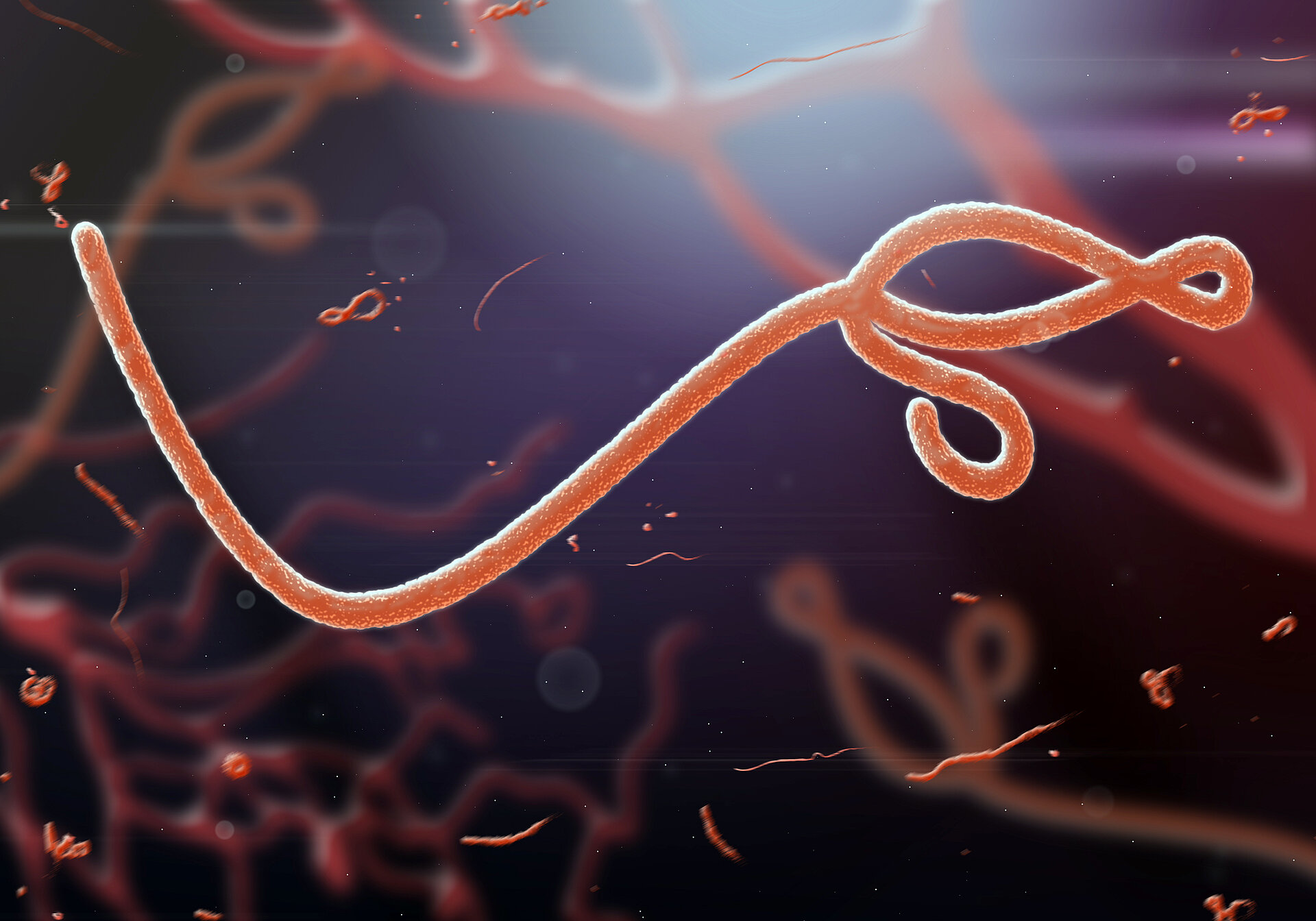
The outbreaks are sudden and severe. The Ebola fever then spreads rapidly throughout the endemic disease area. The rate of fatality often is higher than 50%, sometimes up to 90%. “The disease often begins with nonspecific symptoms and can resemble the flu or gastrointestinal diseases,” says Prof. Fabian Leendertz, director of the Helmholtz Institute for One Health (HIOH) in Greifswald. As the disease progresses, some of those infected suffer from what is known as “hemorrhagic fever,” which can be associated with internal bleeding. “Ultimately, the cause of death in most cases is multiple organ failure,” says Leendertz.
The first documented outbreak was observed in 1976 near a tributary of the Congo river called Ebola, after which the disease is named. The pathogen, the Ebola virus, belongs to the family of filoviruses and includes six species of which four – Orthoebolavirus zairense (formerly known as the “Zaire” species, now referred to simply as the Ebola virus), the “Sudan”, “Bundibugyo” and “Taï Forest” species – cause severe disease in humans. These filamentous viruses can grow up to four micrometers in length. This makes them, purely in terms of size, giants among RNA viruses. They can replicate in many different cells of the human body.
The different strains of Ebola are classified as separate species because they are only distantly related to one another. It is unclear whether cross-immunity exists between different Ebola species—that is, whether vaccinated or recovered individuals are also immune to other Ebola species.
From spillover to outbreaks

Humans are a spillover host and are infected rather “by coincidence” by the Ebola viruses. Their true natural habitat has still not been identified beyond all doubt, but there is much evidence to suggest that the pathogen originated from fruit bats or other bats. Other mammals like apes and antelopes can also get infected.
An Ebola outbreak usually begins with a human-animal contact, meaning that humans get infected through direct contact with infected animals, for example by preparing their meat. After the initial spillover from animals, the virus can also spread from human to human. The disease is transmitted from human to human through body fluids, such as vomit. There is no evidence of airborne transmission. However, infectious droplets can be produced, for example, during vomiting. Infected individuals are contagious from the onset of symptoms. People who have died from Ebola are particularly infectious, as their bodies contain an extremely high viral load.
Since the virus was first identified in 1976, there have been repeated outbreaks and epidemics in Africa. The largest outbreak to date occurred in West Africa from 2013 – it was not detected until 2014 – to 2016; more than 11,000 people died. Together with colleagues, HIOH researcher Leendertz investigated the origin of the epidemic. The team he led was able to show that the outbreak likely began when a child in Guinea became infected through accidental contact with a bat.
Two vaccines against Orthoebolavirus zairense are available and can be used during outbreaks in the form of ring vaccinations. This involves vaccinating not only the direct contacts of infected individuals but also the contacts of those contacts. This strategy helps break chains of transmission and effectively contain the outbreak. Vaccines against other Ebola species are in various stages of development but have not yet been approved.
(mbn, cwe)
Status: June 2026
Further information
- Fact Sheet of the WHO (World Health Organization)
- Fact Sheet of Centers for Disease Control (CDC)
- Information of the European Centers of Disease Control (ECDC)
- Science Magazine: Bat-filled tree may have been ground zero for the Ebola epidemic (News report on the study tracing the source of the 2014 Ebola outbreak)
Involved research groups
-
Epidemiology
 Prof Dr med. Berit Lange
 -
Pathogen Evolution
 Prof Dr Sébastien Calvignac-Spencer
 -
Ecology and Emergence of Zoonotic Diseases
 Prof Dr Fabian Leendertz