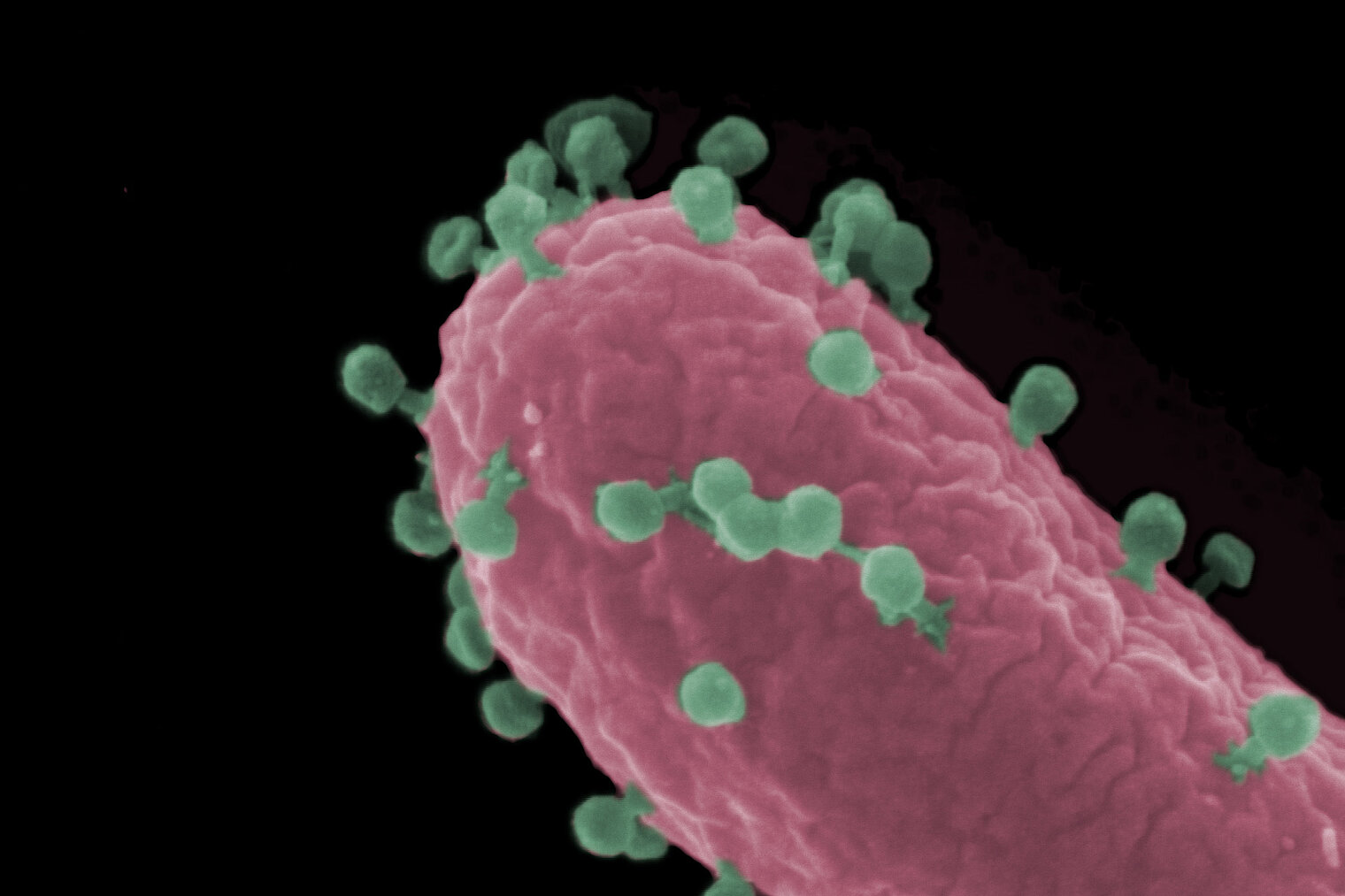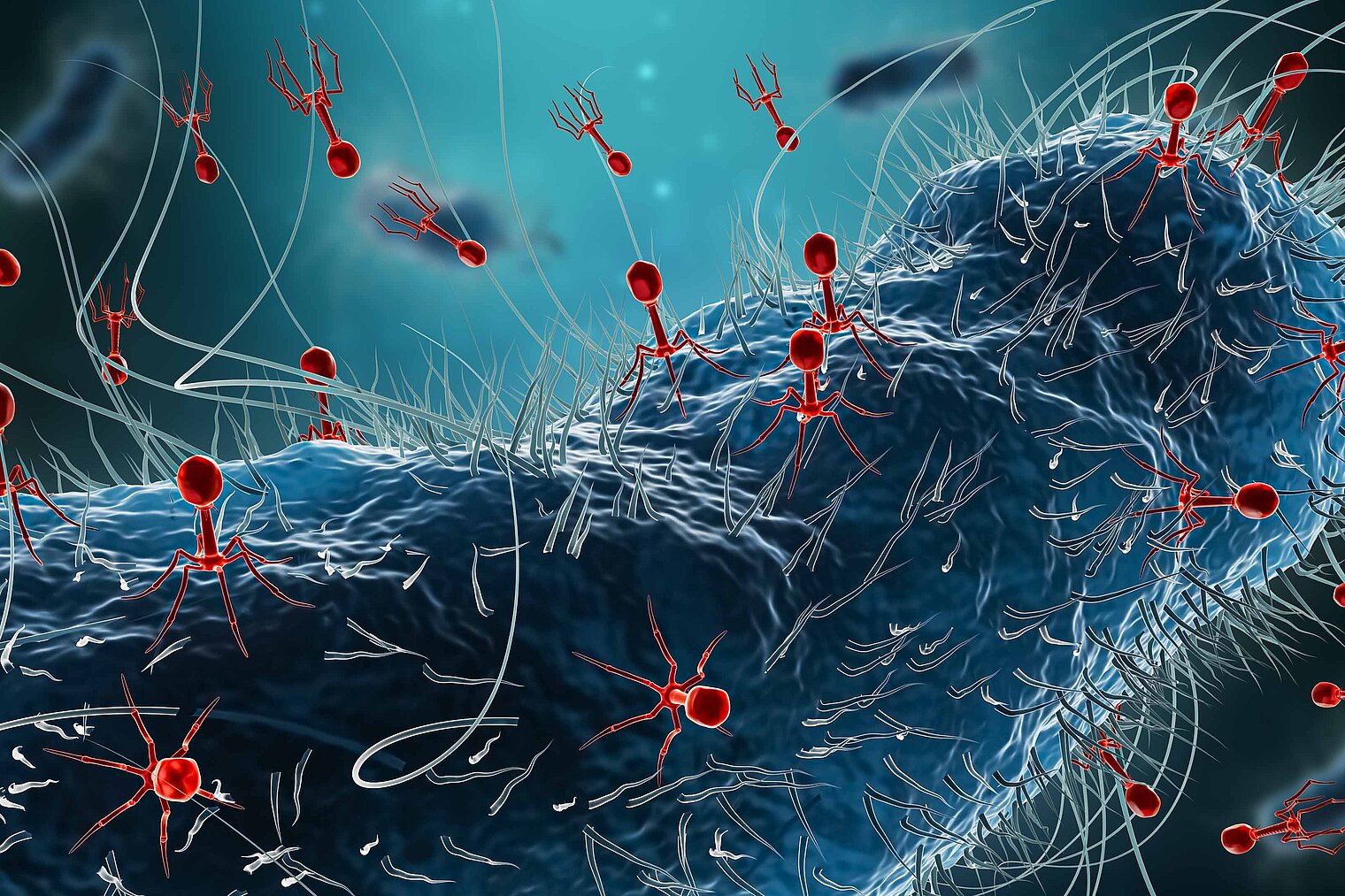
More than four million deaths worldwide each year are linked to antimicrobial resistance. It is therefore also considered a silent pandemic. Bacteriophages (phages) are natural predators of bacteria and, under certain conditions, can serve as a treatment for hard-to-treat bacterial infections. In their typical life cycle, phages inject their genetic material into bacteria and cause them to produce phages. The bacteria are then lysed, and new phage particles are released.
The ERC-funded project PEPHI (Permanent Phage Infections), led by Dr. Milan Gerovac at the HZI, builds on the observation of another mechanism of replication that has received little research attention to date. Some phages can replicate in sync with their host across generations without causing the infected bacteria to lyse—a permanent infection. “When phages replicate without lysing the host, this is difficult to detect experimentally using classical plaque assays,” says Gerovac. In this laboratory method, bacteriophages “eat” visible holes in a dense layer of bacteria. “Thanks to the ERC grant, my team and I will develop new methods to investigate the invisible replication of phages.” Using electron microscopy and single-cell sequencing, the researchers aim to characterize these permanent infections and identify factors that are crucial for entering this replication cycle. In doing so, Gerovac and his team are focusing on nucleus-forming phages. In this group, the phage genome is separated by a protein-based shell during infection and thus protected from bacterial defense systems. The protein shell, also called the phage nucleus, could represent the key structure for this type of replication.
During infections in the human body, conditions are not ideal for the replication of bacteriophages, as the pathogens—which serve as their hosts—are under stress. Nevertheless, nucleus-forming phages can replicate under these conditions. However, for this to be harnessed for phage therapy, the mechanism of replication must still be elucidated. “Looking ahead, we want to specifically bioengineer hypervirulent phages that do not coexist with bacteria but instead directly lyse them,” says Gerovac.
“The ERC Starting Grant is the top recognition for young scientists in Europe and a well-deserved honor for Milan Gerovac. I am pleased that, thanks to the MICROSTAR program, we were able to bring an excellent scientist like him to the HZI as a junior research group leader,” says Prof Josef Penninger, Scientific Director of the HZI. “Milan Gerovac’s research embodies the vision of this program: to decipher the fundamentals of microbial resilience and use bioengineering to develop new medical applications.”
Gerovac has led the junior research group “Complexes in Phage-Infected Cells” within the HZI’s MICROSTAR program since 2024. Previously, he conducted research as a postdoc at the Julius-Maximilians-Universität Würzburg (JMU) and at the Helmholtz Institute for RNA-Based Infection Research (HIRI), a site of the HZI in cooperation with the JMU.