Together with researchers from the Helmholtz Institute for One Health (HIOH) and the WETSCAPES2.0 Collaborative Research Center at the University of Greifswald, the students are investigating the biodiversity of mammals and birds as well as the presence of antimicrobial-resistant bacteria in the Anklam Stadtbruch. Since the dam breach in 1995, the formerly drained mire has developed into one of the region’s most significant re-wetted areas. It makes an important contribution to climate, species, and water conservation and simultaneously serves as a study site for numerous mire research projects. The HIOH is a site of the Helmholtz Centre for Infection Research (HZI) in Braunschweig, in cooperation with the University of Greifswald, the University Medical Center Greifswald, and the Friedrich Loeffler Institute.
Hands-On Research
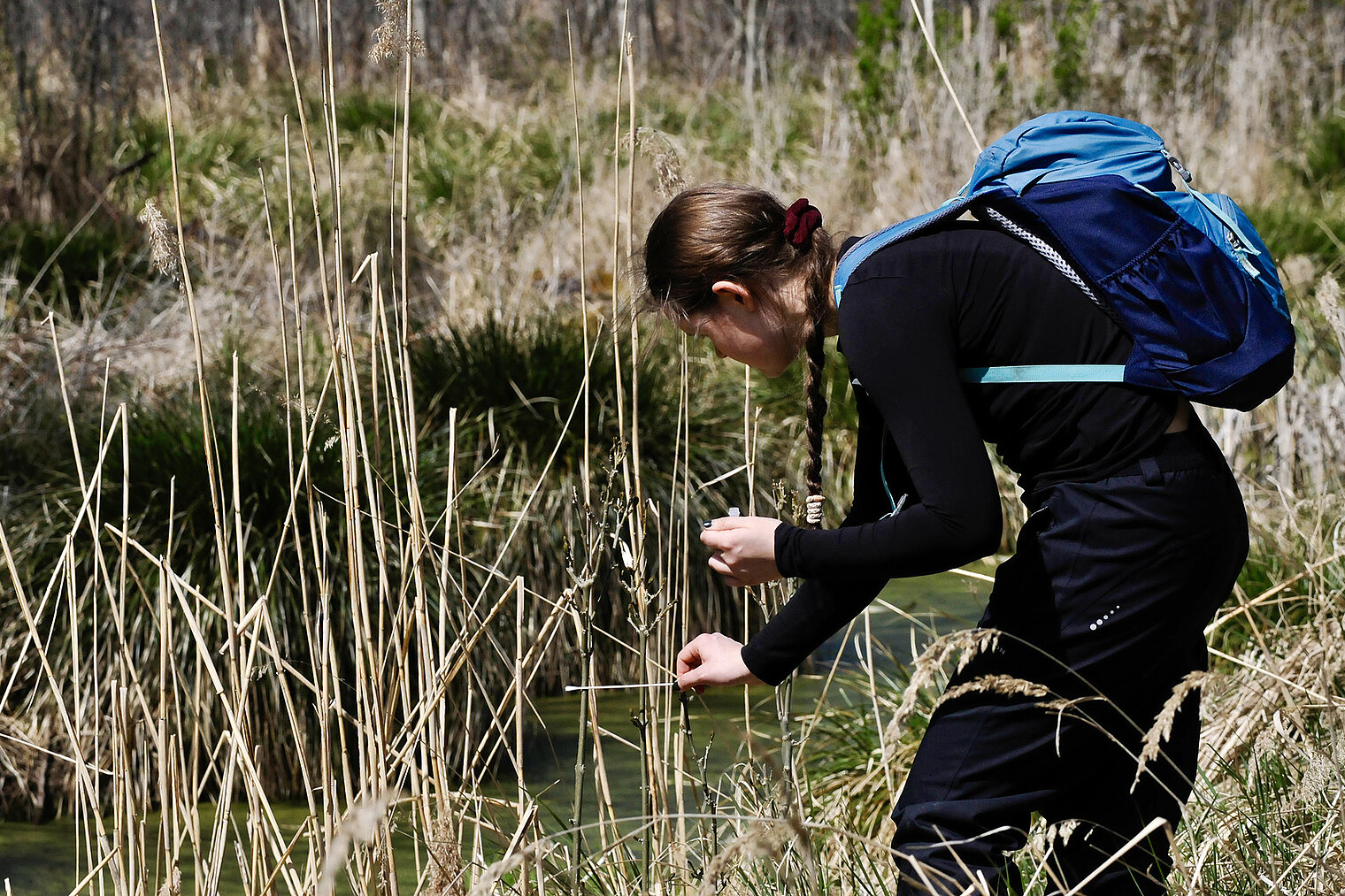
Before heading into the field, the students prepared for their research missions in class. Scientists introduced them to the topics of One Health, biodiversity, and antimicrobial resistance, and guided them in developing their own scientific questions. To enable them to work directly in the mire, they received an introduction to the habitat from mire expert Prof. Gerald Jurasinski. They also learned how to take soil samples, collect leaf swabs, and carefully document their observations.
The highlight of the project was the field research day on April 30, 2026. On site, the students investigated different habitats, including both agriculturally used drained mires and re-wetted areas. In small groups, they developed their own research questions, planned their investigations, collected field samples, documented habitats, and gathered data that will later be scientifically analyzed.
They also became familiar with modern methods such as the analysis of environmental DNA, which allow species to be detected without direct observation.
“Those who conduct their own research gain a much more direct understanding of ecological relationships,” says Prof. Gerald Jurasinski from the Institute of Botany and Landscape Ecology at the University of Greifswald. “Through this project, the students experience why mires are so important for climate, biodiversity, and health—and how science works in practice.”
This is precisely where the citizen science approach comes in. Citizen science means that interested citizens—in this case, students—actively participate in scientific research, for example by collecting data or developing their own research questions.
“We want to show young people the opportunities science offers. It is important to us not only to convey knowledge but also to foster enthusiasm for science,” says Dr. Johanna Eberhard, who coordinates the project at the Helmholtz Institute for One Health. “At the same time, we as scientists have also learned a great deal from the students over the past three years—especially how to communicate content more clearly and how to design methods so they are both understandable and capable of producing reliable scientific data.”
The project combines practical One Health research with cutting-edge scientific questions. In addition to biodiversity, it also focuses on the occurrence of antimicrobial-resistant bacteria. At the same time, it highlights the central role of wetlands for biodiversity and climate protection.
Understanding Wetlands: Their Importance for Climate, Biodiversity, and Health
Wetlands are among the most effective natural carbon sinks on Earth. Although they cover only four percent of the planet’s surface, they store twice as much carbon as all forests combined. When drained, they release large amounts of greenhouse gases. Through rewetting, these emissions can be halted and valuable habitats restored. At the same time, new and dynamic ecosystems emerge, whose development is currently being intensively studied in the WETSCAPES2.0 Collaborative Research Center.
Research Right on Our Doorstep
The CiFly project combines environmental education with current One Health research. Students gain insight into scientific work while actively contributing to data generation, making research tangible. The project has already been carried out with two other student groups. In the first year (2024), students investigated a wide range of areas, mostly in their own neighborhoods. In the second year (2025), the Greifswald Zoo and its surroundings served as the study site. Together with the students, data was collected that allows conclusions about the spatial resolution of biodiversity measurements using the eDNA method. These results are now being published in collaboration with the students.