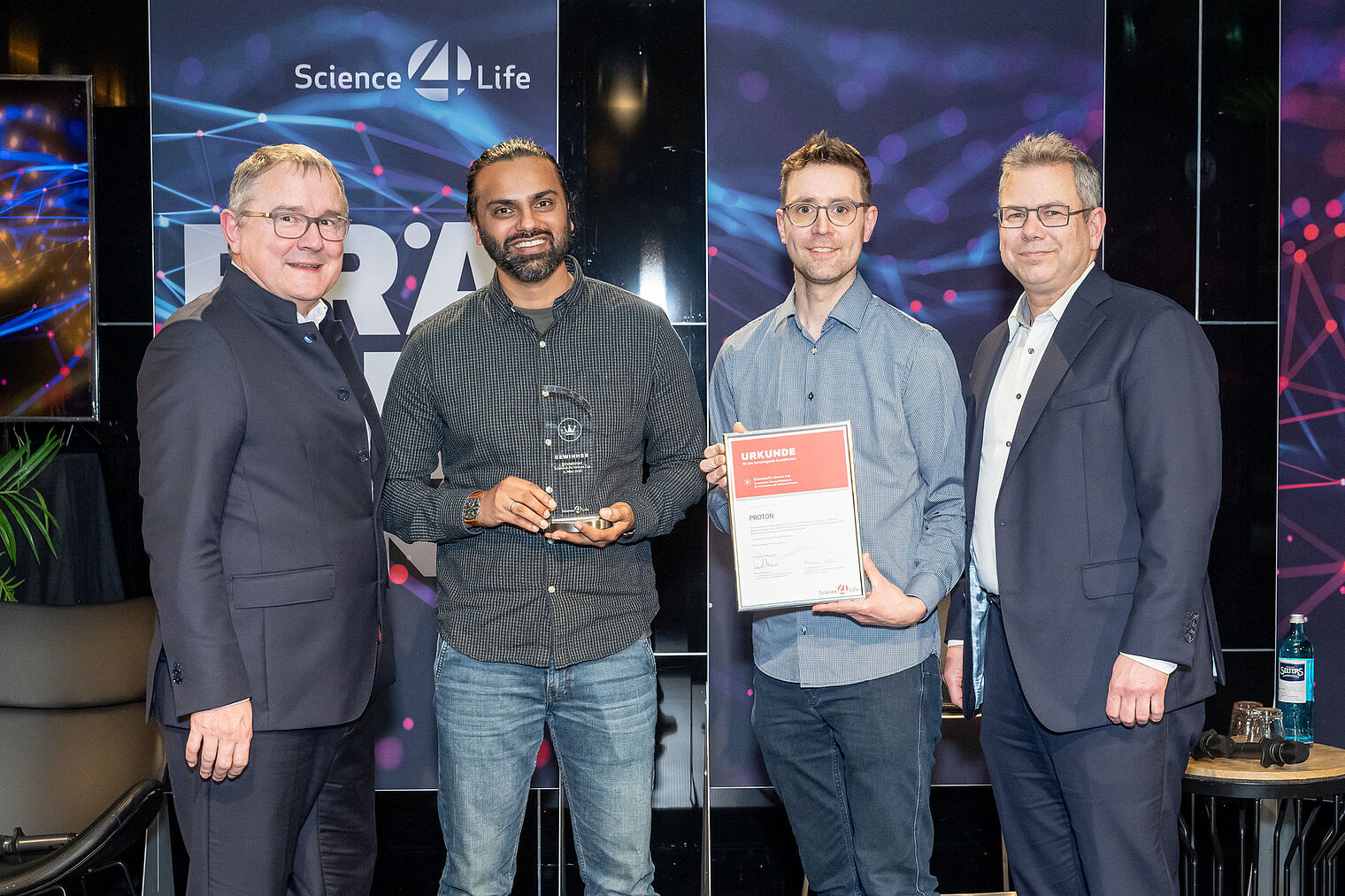
HZI researchers from the PROTON team (from left to right): Dr. Aditya Shekhar, Prof. Mark Brönstrup, Dr. Dominik Heimann
Story
Changing the rules of the race against antibiotic resistance
Instead of killing bacteria with an antibiotic, researchers at the Helmholtz Centre for Infection Research are developing a pathoblocker that disarms Staphylococcus aureus—a promising strategy to slow the emergence of antibiotic resistance.
Tonsillitis, bacterial pneumonia or a middle ear infection? For decades, we could easily treat infections like these with antibiotics. However, as bacteria increasingly display resistance to antimicrobial drugs, this status is being threatened. To safeguard us against a future without antibiotics, researchers at the Helmholtz Centre for Infection Research (HZI) are exploring new treatment strategies. In the department “Chemical Biology” led by Prof. Mark Brönstrup, they are developing a pathoblocker that neutralizes a disease-causing toxin of Staphylococcus aureus without affecting bacterial growth. By disarming the pathogen instead of killing it, this approach could reduce the evolutionary pressure that drives the emergence of antibiotic resistance.
Bacteria can develop antimicrobial resistances through random genetic mutations or the exchange of naturally occurring resistance genes. When antibiotics are used, susceptible bacteria are eliminated while resistant ones survive, multiply and spread. Decades of antibiotic use and overuse in human medicine, veterinary medicine and agriculture have greatly accelerated this evolutionary process.
At the same time, the development of novel antibiotics has slowed dramatically. Very few genuinely new classes of antibiotics reached the market in the past decades, leaving physicians with an increasingly limited arsenal against resistant pathogens. According to a widely cited study published in The Lancet, more than 4.7 million deaths globally were associated with bacterial antimicrobial resistance (AMR) in 2021. Without new countermeasures, this number that could greatly increase. Therefore, researchers are increasingly exploring new concepts to combat antimicrobial resistances.
Pathoblockers: Disarming bacteria instead of killing them
HZI researchers have developed a pathoblocker against Staphylococcus aureus.
At the Helmholtz Centre for Infection Research (HZI), researchers are pursuing such a novel strategy. In the department “Chemical Biology” headed by Prof. Mark Brönstrup, the interdisciplinary team of scientists of the PROTON project is developing a pathoblocker against Staphylococcus aureus. This pathogen is one of the leading causes of antimicrobial resistance-associated deaths worldwide, accounting for more than 500,000 deaths annually.
Unlike conventional antibiotics, the novel drug candidate does not kill the bacteria or inhibit their growth. Instead, it neutralizes a toxin that S. aureus uses to damage host tissues and cause severe disease, effectively disarming the pathogen. Because conventional antibiotics target essential bacterial functions, resistant strains gain an evolutionary advantage. “The race between antibiotics and antibiotic resistance is a race without a finish line,” says Prof. Mark Brönstrup. “Antibiotics that target essential functions will always create selective pressure. Resistance is therefore inevitable; the question is only whether we can slow its emergence and spread.”
Importantly, the compound acts on the toxin after it is secreted by the bacteria. “Crossing the bacterial cell wall and membrane is a major hurdle for many antibiotics”, says microbiologist Dr. Aditya Shekhar, one of the leading scientists in the PROTON team. He illustrates the advantage of their drug candidate with a simple analogy: “We are catching the arrow after it has been shot but before it hits its target.” Additionally, S. aureus appears to lack a direct feedback mechanism that would compensate for the neutralization of this toxin by producing more of it. In other words, the bacteria do not even “notice” that one of their most important weapons has been disabled.
Identification of biomarkers for precision medicine
Pathoblockers are, however, highly specific. Virulence factors differ considerably between bacterial species, meaning that a pathoblocker designed against S. aureus would not work against pathogens such as Pseudomonas aeruginosa. This specificity makes them attractive as precision therapeutics but also means that different pathogens require different pathoblockers.
“We are not only developing the drug itself but also exploring biomarkers that could help clinicians identify the patients most likely to benefit from treatment,” says Shekhar. Such biomarkers could enable more targeted therapies while reducing unnecessary use of broad-spectrum antibiotics.
Closing the gap between discovery and clinical development
Before the PROTON team can start clinical trials with their candidate, it will have to pass critical safety studies. Reaching this stage marks a major milestone and is of the biggest hurdles in antibiotics development. “We are at a critical stage for many antibiotic drug candidates: the transition to clinical development,“ says pharmacist Dr. Dominik Heimann. “We need to close the gap; not just for our project, but for the entire antibiotic pipeline.”
“Our candidate has the potential to be used either on its own or in combination with existing antibiotics,” Heimann explains. “A key part of our work is identifying the clinical setting in which it can provide the greatest benefit.” Despite the challenges, Heimann sees growing momentum in the field. “We are finally seeing greater awareness of antimicrobial resistance and a broader recognition of the societal value of antibiotics,” he says. The potential of the pathoblocker approach is already being recognized. Mark Brönstrup was one of ten global finalists for the “Science Breakthrough of the Year 2026” award by the Falling Walls Foundation, an acknowledgment of the approach's scientific significance.
Mark Brönstrup concludes: “Antibiotics are far more than treatments for everyday infections. They support large parts of modern medicine, from intensive care to cancer therapy and complex surgery. There will be no single solution to preserving their effectiveness. It will require a combination of innovative drugs, smarter diagnostics and responsible antibiotic use.” Pathoblockers will not solve antimicrobial resistance on their own, but they could change the rules of a race against evolution that humanity cannot afford to lose.
The Falling Walls Foundation has nominated two projects from the Helmholtz Centre for Infection Research (HZI) for the “Science Breakthrough of the Year 2026.” The award recognizes groundbreaking scientific advances that break down walls in science and have a global impact. The PROTON team led by Prof. Mark Brönstrup was nominated for the development of a novel antibiotic technology against the pathogen Staphylococcus aureus. In addition, the ENDURIVAC team, represented by Dr. Henning Jacobsen, was recognized for the development of a vaccine platform that induces long-term immunity against respiratory pathogens.
The Science4Life Startup Competition supports teams of founders from the life sciences, chemistry, and energy sectors in transforming their excellent scientific ideas into marketable innovations. In the latest concept phase, the team behind the “PROTON” project from the Helmholtz Centre for Infection Research (HZI) was named the winner. PROTON is developing a novel active substance for the treatment of infections caused by the bacterium Staphylococcus aureus. Of the 91 applications for the concept phase of the Science4Life Venture Cup, the organizers invited ten teams to present their concepts. Ultimately, they selected five winning teams from the fields of life sciences and chemistry, as well as one team from the field of energy research.
In Germany, around 10,000 people die every year from antibiotic-resistant pathogens. At the Helmholtz Centre for Infection Research (HZI) and the Helmholtz Institute for Pharmaceutical Research Saarland (HIPS), scientists are using artificial intelligence to find new antibiotics. In particular, they are looking for active substances that circumvent known resistance mechanisms. They are supported by citizen scientists sending them soil samples from various habitats. On the occasion of World Antimicrobial Resistance Awareness Week 2025, the Helmholtz Association explains how the researchers are fighting against multi-resistant germs.


![[Translate to English:] Charlotte Schwenner](/fileadmin/_processed_/6/9/csm_Charlotte_Schwenner_7952cfe0a7.webp "Dr Charlotte Schwenner")