


Newsroom

Biofilm Pseudomonas
News
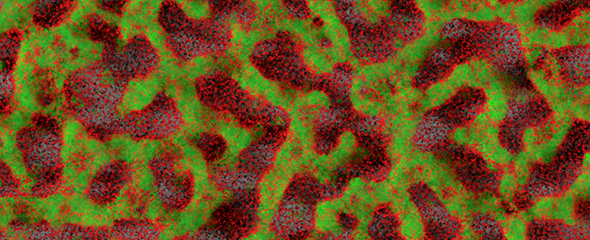
Pseudomonas aeruginosa is a major pathogen that can cause severe infections in various organs of the human body. The infection becomes particularly harmful when the bacteria agglomerate into biofilms: They do this not only to evade attacks of the immune system, but also to protect themselves from the effects of antibiotics. This results in chronic infections that are almost impossible to treat. Scientists from the Helmholtz Institute for Pharmaceutical Research Saarland (HIPS), a joint branch of the Helmholtz Centre for Infection Research (HZI) and Saarland University, developed a molecule, which binds specifically and irreversibly to a key bacterial protein in biofilms. By binding, this molecule blocks an important component of the biofilm and can also visualise the biofilm, when it is labelled with an appropriate dye. The scientists published their results in the international edition of Angewandte Chemie.
07.12.2017
Interview with Silke Tannapfel
Interview
Silke Tannapfel has been the Administrative Director of the HZI since 01 October 2017. A lawyer with a focus on science management, she previously directed the division for extramural research support of the Bavarian State Ministry for Economy and Media, Energy and Technology in Munich. InFact spoke to her about her professional challenges and the first days at the HZI.
01.12.2017
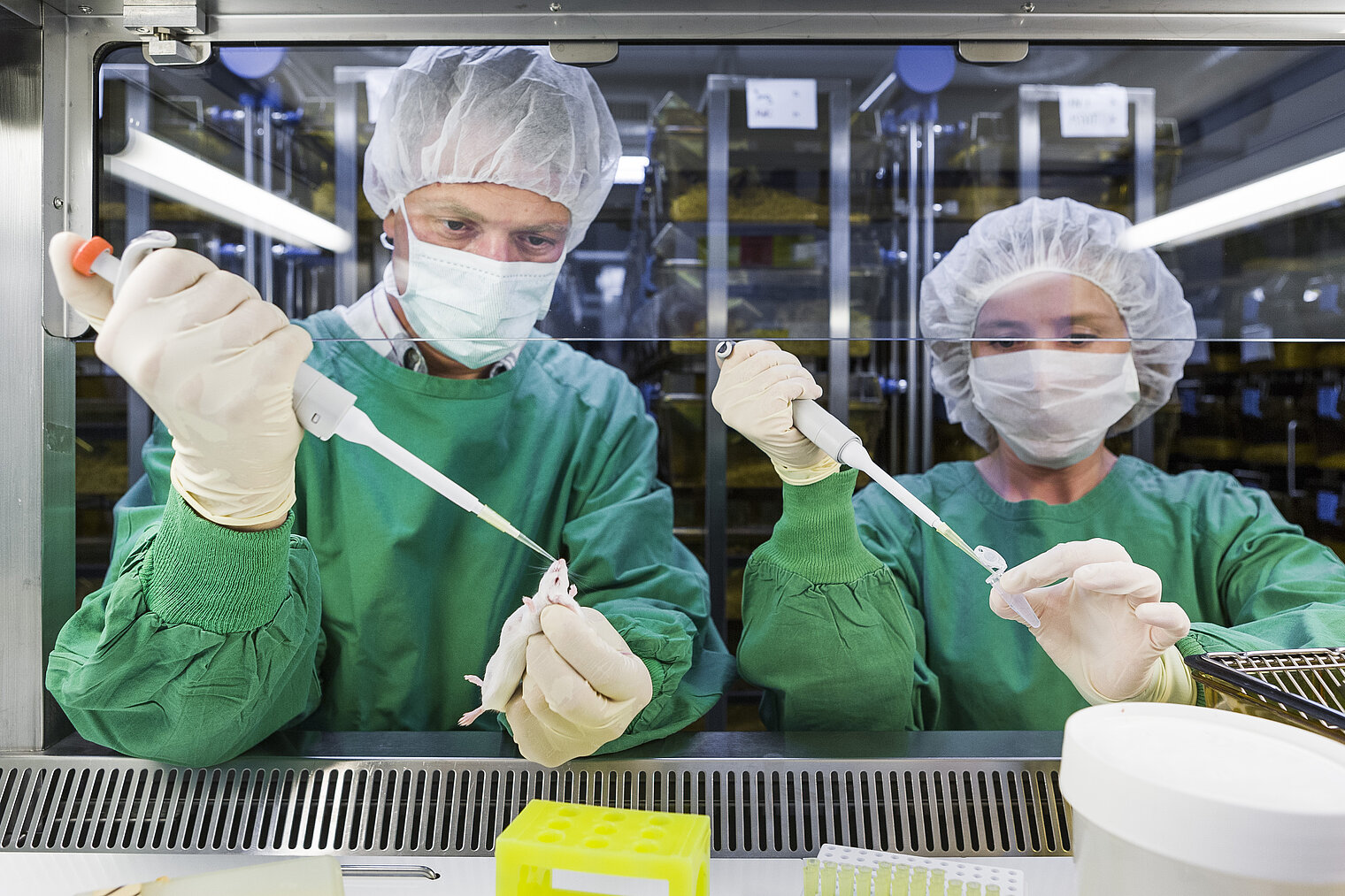
Thomas Ebensen administers a new vaccine in a mouse via the mucous membranes – in humans, this might be done with a nasal spray in the future
Story
Vaccination affords the best protection from many infectious diseases. Vaccines are usually administered with a syringe, but researchers are working on alternatives – like a nasal spray or a vaccination cream. These would not only avoid the unpleasant injection, but even increase the effectiveness. Vaccines usually contain killed or attenuated pathogens and are injected into the patient. This ensures that the entire vaccine truly ends up inside the body. Recognising the pathogens in the vaccine as dangerous foreign material, the immune system prepares itself for defence. The administration by injection with a syringe has its drawbacks as well: It is not the natural pathway of infection and the elicited immune response therefore does not always afford optimal protection from the pathogen. Vaccination also requires trained personnel that simply is not available everywhere and at all times, especially in less developed countries.
01.12.2017
Salmonellen
News
Salmonellae are dangerous pathogens that enter the body via contaminated food and can cause severe infections. But these bacteria are also known to target tumours and to colonise them. Researchers are aiming to make use of this property for cancer therapy, but they are facing a dilemma: Salmonella infections are life-threatening. Scientists from the Helmholtz Centre for Infection Research (HZI) in Braunschweig now undertook a successful step towards the clinical application. They developed a Salmonella strain that induces only a harmless infection, but activates the immune system strongly enough to fight the tumours. Their results were published in the journal OncoImmunology.
23.10.2017
Gruppenbild
News
On 6 October 2017 the "Science Campus Braunschweig-Süd" has been solemnly inaugurated by Lower-Saxony's Minister for Science and Culture, Gabriele Heinen-Kljajić, and Braunschweig's Mayor, Ulrich Markurth. The ceremony was attended by guests from science, industry and politics and has been a highlight in Braunschweig's anniversary year "10 years City of Science" and an important milestone in the development of "Research Region Braunschweig". The future campus partners include the Helmholtz Centre for Infection Research (HZI), the German Center for Infection Research (DZIF), the Leibniz Institute DSMZ-German Collection of Microorganisms and Cell Cultures, the Technische Universität Braunschweig, the Fraunhofer Institute for Toxicology and Experimental Medicine ITEM and the Biotechnologische Schülerlabor Braunschweig (BioS). The new joint umbrella brand "Science Campus Braunschweig-Süd" is to expand the regional and Germany-wide visibility of the modern Life Science campus, promote the networking of the partnering institutions and attract new cooperation partners and young talent. In addition, with the support of the city of Braunschweig, a new signposting concept has been implemented off-campus.
06.10.2017
Bakterien
News
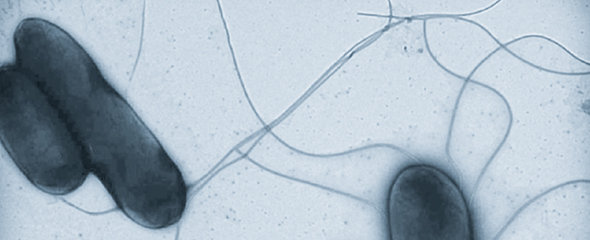
Microbes may be invisible to the eye, but they are ubiquitous. They are the influential forces behind the regulation of key processes in our environment, for example the carbon cycle. Many microorganisms are not yet known or cannot be maintained in culture. More information about the diversity of species is provided by modern molecular genetic methods, which nowadays allow the entirety of the genome of a habitat – the so-called metagenome – to be investigated. However, the complex analysis of this vast amount of data with a multitude of computer programmes still poses major problems for the researchers. For this reason, scientists of the Helmholtz Centre for Infection Research (HZI) in Braunschweig, the University of Vienna and the University of Bielefeld just started an initiative titled "CAMI – Critical Assessment of Metagenome Interpretation", that tests the tools of metagenome analysis and defines new standards and application options. The researchers published their results in the scientific journal Nature Methods.
04.10.2017

HZI in the media

Lange, Leiterin der Abteilung Epidemiologie am Helmholtz-Zentrum für Infektionsforschung in Braunschweig erwartet insgesamt einen typischen

12.11.2026
|
Wiesbadener Kurier

... Technischen Universität Braunschweig, Forschungsgruppenleiter am Helmholtz Zentrum für Infektionsforschung.


Nach seiner Promotion über ...

09.11.2026
|
Radio38

WDR am 05.11.2026: Vitamine sind lebenswichtig. Viele greifen deshalb zu Kapseln, Pulvern und Brausetabletten, um mit einer Extraportion nachzuhelfen.


Das Geschäft boomt: Hersteller versprechen mehr Energie, ein stärkeres Immunsystem, gesünderes Altern und Schutz vor Krankheiten

06.11.2026
|
ARD Mediathek

Jörg Vogel, Direktor des Helmholtz-Instituts für RNA-basierte Infektionsforschung und Sprecher der Leopoldina-Arbeitsgruppe RNA-basierte ...

04.11.2026
|
Tagesschau

... Team der MHH beteiligen sich das Helmholtz-Zentrum für Infektionsforschung, das Fraunhofer-Institut für Toxikologie und ...

04.11.2026
|
Deutsches Ärzteblatt

... leitete er eine Forschungsgruppe am Helmholtz-Institut für RNA-basierte Infektionsforschung (HIRI) in Würzburg.


Vorbeugen - ...

02.11.2026
|
Management & Krankenhaus

"Trump ist eine Bedrohung für die Demokratie und Freiheit. Eine Rückkehr in die USA ist beruflich keine Option mehr", so Biologin Dr. Elsa Anderson. Forschenden droht in den USA in der zweiten Amtszeit von Donald Trump der Verlust ihrer wissenschaftlichen Freiheit, sie suchen des

02.11.2026
|
arte

... nach dem Saarland benannt.


Seit gut drei Jahren läuft das vom Helmholtz-Institut für Pharmazeutische Forschung ...

02.11.2026
|
Tagesschau

... ist Leiterin der Abteilung Epidemiologie am Helmholtz-Zentrum für Infektionsforschung (HZI) und Mitglied der Ständigen Impfkommission ...

30.10.2026
|
Focus Online

von Mikroorganismen und Zellkulturen und des Helmholtz-Zentrums für Infektionsforschung zwei bislang unbekannte Naturstoffe entdeckt. Die

30.10.2026
|
Bionity.COM

Researchers at the Helmholtz Centre for Infection Research (HZI) and its Saarland University partner site, the Helmholtz Institute for

27.10.2026
|
Scienmag Science Magazine

experimental and modeling study led by scientists at the Helmholtz Centre for Infection Research in Braunschweig. The researchers found that

26.10.2026
|
Bioengineer.org

Register now for the HZI newsletter