


Newsroom

Darmflora
News
Intestinal bacteria are suspected of causing cardiovascular disease, since they produce trimethylamine as a metabolic product that is hazardous to humans. They utilise food ingredients that are present mainly in meat and eggs. The causal relationships are still vague at this time, since important insights into these microbial communities are still lacking. A research team from the Helmholtz Centre for Infection Research (HZI) recently developed a special function-based diagnostic method that allows the measurement of the trimethylamine production potential of intestinal communities and identification of the specific bacterial species involved in this process. Based on these insights, the microbiome may become a target of therapeutics in the distant future. The researchers published the results in Microbiome.
06.06.2017
Gruppenbild
News
In recent years, more and more pathogens have become resistant to previously time-proven antibiotics. This scenario gives scientists all over the world cause to find new anti-infective substances and to develop them for application in medicine. A true opportunity for the discovery of new antibiotics is the investigation of previously unknown bacteria and fungi from habitats that have not yet been examined thoroughly, as these microorganisms produce a wealth of chemical substances with antibiotic activity. Scientists from the Helmholtz Centre for Infection Research (HZI) have isolated a large number of new bacterial strains, some of which show an activity against resistant pathogens and have already been promoted to the early preclinical development phase.
20.04.2017
Eva Medina
Interview
More and more pathogens are developing resistances to antibiotics. There is therefore an urgent need for new anti-infectives. In this regard, Eva Medina of the Helmholtz Centre for Infection Research is looking for therapeutic alternatives that will circumvent the renewed formation of antibiotic resistance.
03.04.2017
Melanomzelle
News
Cells inside the human body contain a flexible polymer network called the cytoskeleton which consists of actin filaments - and other components - and undergoes constant assembly and disassembly. This turnover of actin filaments allows cells to change shape and move. Such movements are important for example during embryonic development, wound healing but also for a properly operating immune system. To be able to move through tissue, cells need to expend energy and apply force. For example, immune cells advance into all regions of our body to detect and fight pathogens. In turn, though, some pathogens can abuse the cytoskeleton to adhere to or penetrate into cells.
22.03.2017
Salmonellen
News
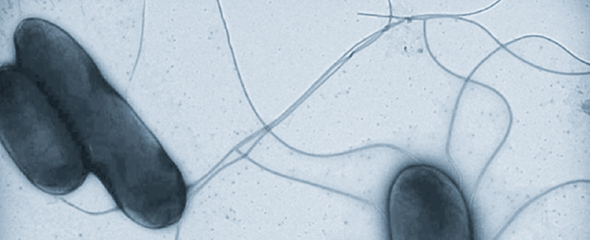
Many bacteria move by rotating long, thin filaments called flagella. Flagella are made of several tens of thousands building blocks outside the bacterial cell and grow up to ten times longer than the bacterial cell body. They allow bacteria to swim towards a nutrient source or to approach cells of the human mucosa in order to infect them. This means that flagella are also tools in infection processes and might be suitable as potential targets for new agents against pathogenic bacteria. The details of how flagella are assembled and how this process might be inhibited remained elusive. Scientists of the Helmholtz Centre for Infection Research (HZI) in Braunschweig now elucidated this mechanism using real-time observations of growing flagella. The researchers published their results in the freely accessible journal, eLife.
13.03.2017
menschliche dendritische Zelle
News
There is a continuing need for effective vaccinations against viruses which specifically infect the liver. According to the World Health Organization WHO, approximately 400 million people around the world are infected by hepatitis B or hepatitis C viruses and approximately 1.4 million people succumb to them each year. Moreover, chronic hepatitis B or C infections are amongst the most common causes of liver cancer and therefore are some of the most common reasons for a liver transplantation. Recently, a research team directed by Prof Dunja Bruder, who holds appointments at both the Helmholtz Centre for Infection Research (HZI) and the Otto von Guericke University Magdeburg, successfully targeted a vaccine specifically to recognition molecules of certain immune cells which allowed them to elicit an effective immune defence in the liver. The researchers published their results in Scientific Reports.
07.03.2017

HZI in the media

... beschleunigen


Das DFKI hat zusammen mit dem Helmholtz-Institut für Pharmazeutische Forschung Saarland (HIPS), der ...

02.08.2026
|
SR Saarländischer Rundfunk

... Forschungszentrum Fahrzeugtechnik (NFF) oder dem Helmholtz-Zentrum für Infektionsforschung (HZI).


Am 24. März 19973 ...

01.08.2026
|
t-online.de

... including to Germany, for further testing. Professor Fabian Leendertz at the Helmholtz Institute for One ...

31.07.2026
|
Deutsche Welle

Spannend: Am Exponat des Helmholtz-Instituts Saarland kann man nach Bodenbakterien suchen. | Foto: Ilja C. ...

30.07.2026
|
Die Rheinpfalz

Sprachmodellen und Einzelzellanalysen bei, das Helmholtz-Institut für Pharmazeutische Forschung Saarland übernimmt die chemische Synthese ...

29.07.2026
|
Deutsches Ärzteblatt

... in Wirkstoffdesign, Sprachmodellen und Einzelzellanalysen bei, das Helmholtz-Institut für Pharmazeutische Forschung Saarland ( HIPS ) ...

24.07.2026
|
Management & Krankenhaus

together the Fraunhofer ITMP in Hamburg, the Helmholtz Centre for Infection Research (HZI) in Braunschweig and Enamine Deutschland GmbH from

23.07.2026
|
Associated Press

such a drug candidate. HIPS is a site of the Helmholtz Centre for Infection Research (HZI) in collaboration with Saarland University. The

22.07.2026
|
Technology Networks

Researchers at the Helmholtz Institute for RNA-based Infection Research (HIRI) in Würzburg, a site of the Braunschweig Helmholtz Center for

20.07.2026
|
Medical Xpress

Forschende des Helmholtz-Instituts für RNA-basierte Infektionsforschung (HIRI) in Würzburg, einem Standort des Braunschweiger Helmholtz- ...

20.07.2026
|
DeutschesGesundheitsPortal

Berit Lange, Leiterin der Abteilung Epidemiologie, Helmholtz-Zentrum für Infektionsforschung (HZI) in Braunschweig , ergänzt: „Eine ...

17.07.2026
|
Biermann Medizin

Prof. Dr. Berit Lange gegenüber dem SMC . Sie ist Leiterin der Abteilung Epidemiologie am Helmholtz-Zentrum ...

15.07.2026
|
Apotheken Umschau

Register now for the HZI newsletter