Newsroom

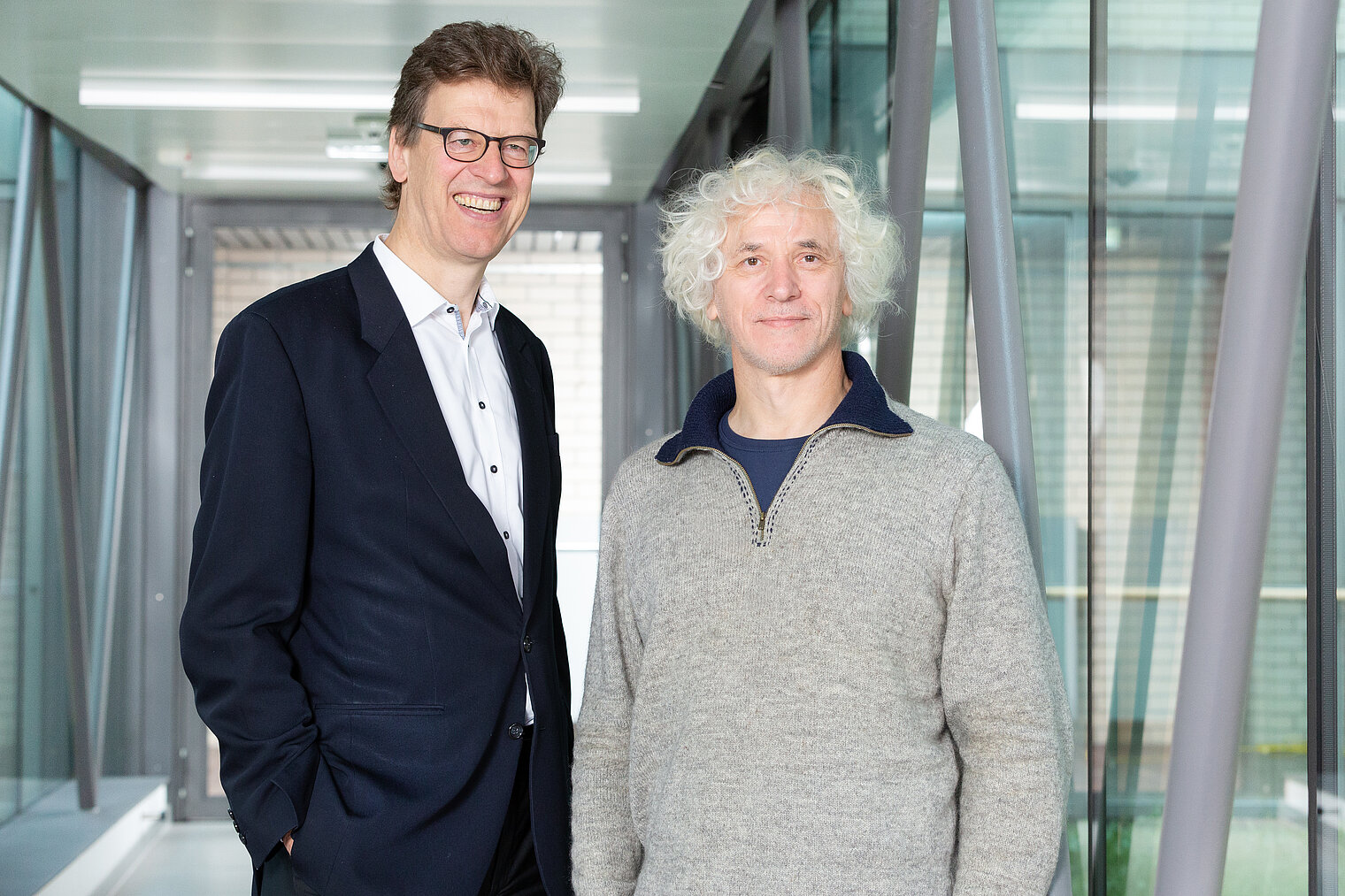
Portrait of Prof Gérard Krause
News
The 2022 Prize for Translational Infection Research of the German Center for Infection Research (DZIF), endowed with 5,000 euros, goes to the DZIF scientist and epidemiologist Gérard Krause, head of the department "Epidemiology" at the Helmholtz Centre for Infection Research (HZI) in Braunschweig. Prof Krause researches the spread and clinical consequences of infectious diseases in the population and develops methods for their prevention, diagnosis and epidemic control. He has now been honoured with the DZIF Prize for his outstanding contributions in the field of translational infection epidemiology and in particular for the development of the epidemic management system SORMAS.
09.01.2023
Prof. Dr. Chase Beisel and Dr. Oleg Dmytrenko.
News
It is an unexpected discovery by scientists at the Helmholtz Institute Würzburg in cooperation with Benson Hill, Inc. (Missouri) and Utah State University in the U.S.: They have found a nuclease, which they dubbed Cas12a2, that represents an entirely new type of CRISPR immune defense. Unlike any other previously known nuclease of the CRISPR-Cas immune system, the source of "gene scissors", Cas12a2 destroys DNA to shut down an infected cell. The findings could lead to new CRISPR technologies for molecular biology diagnostics, among other applications, and were published today in the journal Nature.
04.01.2023
Portrait
News
The lawyer Christian Scherf will start as Administrative Director at the Helmholtz Centre for Infection Research (HZI) in Braunschweig on 1 January 2023. The former Chancellor of the Berufliche Hochschule Hamburg succeeds Silke Tannapfel, who left the HZI at the end of 2021 to join the Hessian Ministry of Science and the Arts. The position of Administrative Director was temporarily taken over by Elisabeth Gerndt, authorised signatory and head of the Finance and Controlling Department, until 31 December 2022.
23.12.2022
Aktinzytoskelett einer migrierenden Zelle mit Zellkern
News
Bacterial pathogens like Salmonella, Shigella, Listeria and many others exploit the protein skeleton of the cells they infect in order to spread throughout the host. However, how is this so-called cytoskeleton of host cells assembled and remodelled? Answers to this question can provide new approaches for combatting the causative agents of infectious diseases. An international team of researchers including HZI-members have now unravelled precise molecular mechanisms of activation of a key signalling unit in cytoskeletal remodelling. These recent results have just appeared in Science Advances.
15.12.2022
Bakterien
News
The Pseudomonas aeruginosa bacterium is a widespread and dangerous hospital germ. It infects the respiratory tract and lungs and possesses natural resistance to numerous antibiotics. There is a search for so-called pathoblockers ongoing to be able to combat the bacterium better in the future. The focus here is not on killing the pathogen, as would be the case with antibiotic treatment, but rather on specifically eliminating or ameliorating its pathogenic effect. In an infection with Pseudomonas aeruginosa, the blue-green metabolic product pyocyanin, amongst other factors, contributes to the emergence of inflammatory processes and has a tissue-damaging effect. The infection would be less severe if the production of this substance could be prevented by means of a pathoblocker. In order to do this though, the exact molecular mechanisms responsible for the production of pyocyanin within the bacterial cell must first be understood. The research team led by Prof Wulf Blankenfeldt, who is the head of the "Structure and Function of Proteins" department at the Helmholtz Centre for Infection Research (HZI) in Braunschweig, recently discovered more details of the interplay of proteins that is required for production of pyocyanin applying modern protein biochemical analysis methods. In the course of this work, he has been able to clarify the central function of a protein called PqsE as a "moonlighter” in this process. The study is published in the current issue of Nature Communications.
14.12.2022
Portraits
News
Clarivate Analytics, a company specialising in bibliometric data, publishes an annual list of researchers who have had a significant impact on their field by publishing several highly-cited papers over the last ten years. In 2022, three department leaders of the Helmholtz Centre for Infection Research (HZI) made it onto the list of “Highly-cited researchers”: Bioinformatician Prof Alice McHardy, biotechnologist Prof Marc Stadler and biochemist Prof Jörg Vogel were recognised for their influence on their respective fields.
25.11.2022

HZI in the media

... haben. Ein Forschungsteam des Helmholtz-Instituts für RNA-basierte Infektionsforschung (HIRI) in Würzburg hat in Zusammenarbeit ...

14.04.2026
|
PresseBox - DE

... der Infektion und Nozizeption“ am Helmholtz-Zentrum für Infektionsforschung (HZI) in Braunschweig. Nozizeption ist der Fachbegriff ...

14.04.2026
|
Verband Deutscher Biologen e.V.

... recht nicht bei Fabian Leendertz, der in Greifswald das „Helmholtz-Institut für One Health“ leitet. Im ...

14.04.2026
|
FAZ.NET

... sich auch das Helmholtz-Institut für Pharmazeutische Forschung Saarland ( HIPS ), das Helmholtz-Zentrum für Infektionsforschung ( HZI ) ...

09.04.2026
|
Deutsches Ärzteblatt

... ÖAW in Wien und nun Gruppenleiter am Helmholtz Zentrum für Infektionsforschung in Braunschweig, forscht an ...

08.04.2026
|
DerStandard.de

... group within the Microstar Program at the Helmholtz Centre for Infection Research (HZI) and a ...

31.03.2026
|
Informations Dienst Wissenschaft

... an der Medizinischen Hochschule Hannover und am Helmholtz Institut für Infektionen in Braunschweig die Wirkung ...

28.03.2026
|
Hamburger Abendblatt

led by wildlife veterinarian Fabian Leendertz, who heads the Helmholtz Institute for One Health, took hundreds of samples from meat and

27.03.2026
|
Science.org

Gesellschaft. Apropos Standort Braunschweig: Auch das Helmholtz-Zentrum für Infektionsforschung HZI, in dessen Räumlichkeiten auf dem ...

27.03.2026
|
transkript

Helmholtz Centre for Infection Research


After infection with SARS-CoV-2, up to 10 percent of people in Germany go on to develop Long COVID.

26.03.2026
|
Mirage.News

... von verschiedenen Hörnchen, wie jüngste Erkenntnisse des Helmholtz Instituts für One Health in Greifswald kürzlich ...

26.03.2026
|
Tagesschau

zur Bekämpfung der Tuberkulose und des Helmholtz-Zentrums für Infektionsforschung erstellt. Zahlreiche weitere Fachgesellschaften und

24.03.2026
|
Deutsches Ärzteblatt

Register now for the HZI-Newsletter