

Newsroom

Scientists stand in front of a screen on which the online monitoring system SORMAS is displayed.
Story
In autumn 2017, Nigeria suspected an outbreak of human monkey pox. Immediately, epidemiologists adapted their online disease surveillance system and travelled to Nigeria to support the locals. The 2014 Ebola outbreak in West Africa revealed an urgent need of efficient disease surveillance systems, because it became evident that the outcome of an epidemic also depends on how fast disease control measures are implemented. HZI scientists from the Department of Epidemiology, led by Gérard Krause, teamed up with Nigerian scientists and developed a mobile-based application, which allows real-time data collection and application of disease control measures called Surveillance, Outbreak Response Management and Analysis System (SORMAS).
01.05.2018
Thomas Ebensen administers a new vaccine in a mouse via the mucous membranes – in humans, this might be done with a nasal spray in the future
Story
Vaccination affords the best protection from many infectious diseases. Vaccines are usually administered with a syringe, but researchers are working on alternatives – like a nasal spray or a vaccination cream. These would not only avoid the unpleasant injection, but even increase the effectiveness. Vaccines usually contain killed or attenuated pathogens and are injected into the patient. This ensures that the entire vaccine truly ends up inside the body. Recognising the pathogens in the vaccine as dangerous foreign material, the immune system prepares itself for defence. The administration by injection with a syringe has its drawbacks as well: It is not the natural pathway of infection and the elicited immune response therefore does not always afford optimal protection from the pathogen. Vaccination also requires trained personnel that simply is not available everywhere and at all times, especially in less developed countries.
01.12.2017
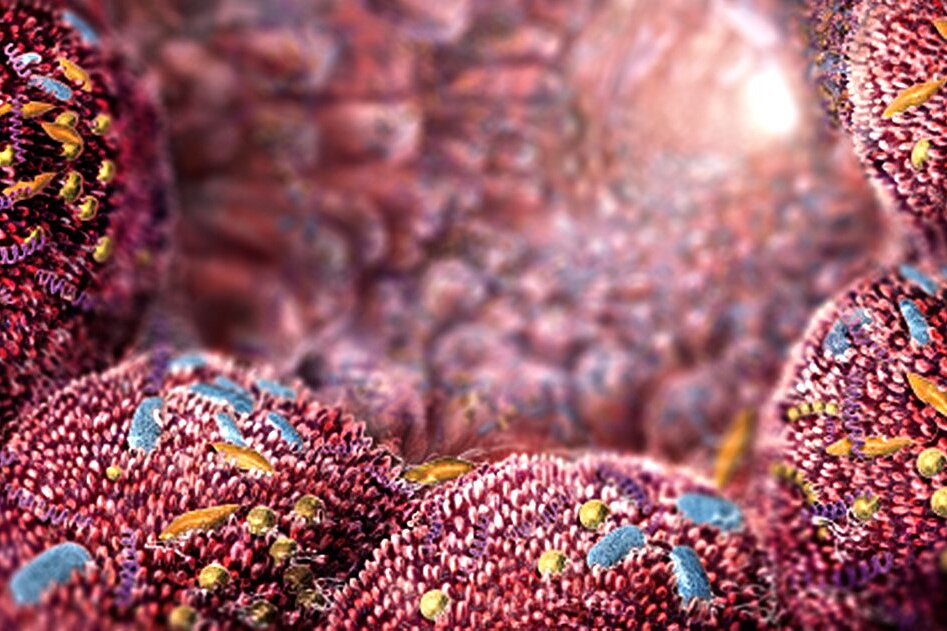
gut mucosa
Story
Over the past few years, public awareness of the microbial communities in our gut has grown significantly – partially thanks to Giulia Enders' book "Gut: The Inside Story Of Our Body's Most Under-Rated Organ". Scientific studies on antibiotics and the microbiota have also attracted attention: The use of these products is hypothesised to disrupt the sensitive inhabitants of our intestine and may cause serious damage. So how can we protect our gut flora against this?
04.09.2017

HZI in the media

... Technischen Universität Braunschweig, Forschungsgruppenleiter am Helmholtz Zentrum für Infektionsforschung.


Nach seiner Promotion über ...

09.11.2026
|
Radio38

WDR am 05.11.2026: Vitamine sind lebenswichtig. Viele greifen deshalb zu Kapseln, Pulvern und Brausetabletten, um mit einer Extraportion nachzuhelfen.


Das Geschäft boomt: Hersteller versprechen mehr Energie, ein stärkeres Immunsystem, gesünderes Altern und Schutz vor Krankheiten

06.11.2026
|
ARD Mediathek

Jörg Vogel, Direktor des Helmholtz-Instituts für RNA-basierte Infektionsforschung und Sprecher der Leopoldina-Arbeitsgruppe RNA-basierte ...

04.11.2026
|
Tagesschau

... Team der MHH beteiligen sich das Helmholtz-Zentrum für Infektionsforschung, das Fraunhofer-Institut für Toxikologie und ...

04.11.2026
|
Deutsches Ärzteblatt

... leitete er eine Forschungsgruppe am Helmholtz-Institut für RNA-basierte Infektionsforschung (HIRI) in Würzburg.


Vorbeugen - ...

02.11.2026
|
Management & Krankenhaus

"Trump ist eine Bedrohung für die Demokratie und Freiheit. Eine Rückkehr in die USA ist beruflich keine Option mehr", so Biologin Dr. Elsa Anderson. Forschenden droht in den USA in der zweiten Amtszeit von Donald Trump der Verlust ihrer wissenschaftlichen Freiheit, sie suchen des

02.11.2026
|
arte

... nach dem Saarland benannt.


Seit gut drei Jahren läuft das vom Helmholtz-Institut für Pharmazeutische Forschung ...

02.11.2026
|
Tagesschau

... ist Leiterin der Abteilung Epidemiologie am Helmholtz-Zentrum für Infektionsforschung (HZI) und Mitglied der Ständigen Impfkommission ...

30.10.2026
|
Focus Online

von Mikroorganismen und Zellkulturen und des Helmholtz-Zentrums für Infektionsforschung zwei bislang unbekannte Naturstoffe entdeckt. Die

30.10.2026
|
Bionity.COM

Researchers at the Helmholtz Centre for Infection Research (HZI) and its Saarland University partner site, the Helmholtz Institute for

27.10.2026
|
Scienmag Science Magazine

experimental and modeling study led by scientists at the Helmholtz Centre for Infection Research in Braunschweig. The researchers found that

26.10.2026
|
Bioengineer.org

... am Helmholtz Zentrum für Infektionsforschung (HZI) und dessen Saarbrücker Standort, dem Helmholtz-Institut für Pharmazeutische ...

26.10.2026
|
Verband Deutscher Biologen e.V.

Register now for the HZI newsletter